



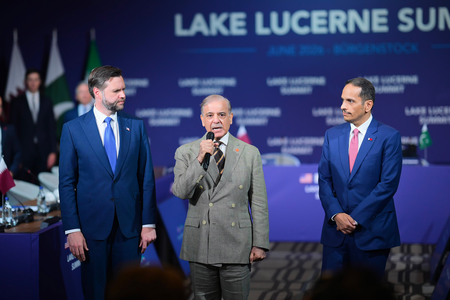
New Delhi, June 24 (IANS) Pakistan’s attempts at mediating between the US and Iran initially boosted its diplomatic profile, but has also exposed Islamabad to risks such as the alienation of allies like Saudi Arabia, raising suspicions in Washington and Tehran, as well as its dependence on countries like China and Qatar to actually steer the talks.
The exercise has unsettled Saudi Arabia because it appeared to tilt Islamabad closer to Tehran at a time when Riyadh expected Pakistan’s alignment with Gulf security priorities.
While Pakistan tried to balance consultations with Saudi Arabia, its visible embrace of Iran and military-led diplomacy raised doubts in Riyadh about Islamabad’s reliability.
Saudi Arabia has long viewed Pakistan as a strategic partner, reinforced by the 2025 Strategic Defence and Military Agreement (SDMA).
Riyadh thus expected Islamabad to remain firmly in the Gulf camp.
“Although it appears that Riyadh has been on board with regard to Pakistan’s diplomatic initiative with Iran, if Iranian attacks restart against Saudi Arabia, Riyadh will expect Pakistan to actively contribute to its defence under their security agreement,” observed an article this March on the website of the American thinktank Stimson.
“Moreover, Pakistan’s relationship with the United Arab Emirates has already been affected by this conflict, with the UAE demanding repayment of a major loan. If the fragile US-Iran ceasefire falters, Pakistan’s balancing act among the U.S., Iran, and Saudi Arabia will likely become untenable,” warned the article.
An opinion piece in Al Jazeera this March had also stated, “Now the pact is being tested under conditions neither side anticipated.”
Al Jazeera, which calls itself the first independent news channel in the Arab world, is funded in part by the Qatari government. It noted that when Iranian drones and missiles hit Gulf targets, Pakistan condemned both US–Israel on the killing of Ayatollah Khamenei and Iran’s retaliatory strikes, trying to appear balanced.
Pakistan Deputy Prime Minister and Foreign Minister Ishaq Dar engaged in “shuttle communication” between Tehran and Riyadh, securing assurances that Saudi soil would not be used against Iran, which briefly limited Iranian strikes, it added.
Now, Pakistan’s neutral posture is under severe strain; its defence pact ties it to Saudi Arabia, but geography and sectarian dynamics bind it to Iran.
“Islamabad likely never expected to find itself caught between Tehran and Riyadh, particularly after the China-brokered rapprochement between Saudi Arabia and Iran in 2023,” the opinion piece stated further.
If the region’s volatility is not contained soon, Pakistan will find it difficult to balance itself, the opinion piece said, quoting analysts.
Apart from such observations, hosting Iranian delegations in Islamabad and giving Tehran’s leadership a platform made Saudi Arabia uneasy, as it suggested Pakistan was legitimising Iran’s position.
Incidentally, Pakistan’s Army Chief Asim Munir projected himself as personally driving negotiations with Iran’s Revolutionary Guards.
This military-heavy mediation raised concerns in Riyadh that Pakistan was prioritising Iran’s trust over Gulf sensitivities.
It has also caught wide attention that despite projecting itself as the negotiator, Pakistan has heavily depended on other nations’ support.
As the Stimson article mentioned that the March 31 joint statement by Pakistan and China and their proposal for a five-point plan to end the war on Iran recognised “Pakistan’s limitations as a mediator and the need for a major global actor to underpin its diplomatic efforts”.
And as widely reported recently, the latest attempt in Switzerland for a truce had Qatar steering it, though quietly.
Several reports have suggested that the Iranian media has generally downplayed Pakistan’s mediation role in US–Iran talks while highlighting Qatar as the more credible and effective broker.
The coverage appeared to highlight Iran’s own diplomatic initiatives or Qatar’s mediation, while Pakistan’s role being held as limited or supportive.
–IANS
jb/rad