

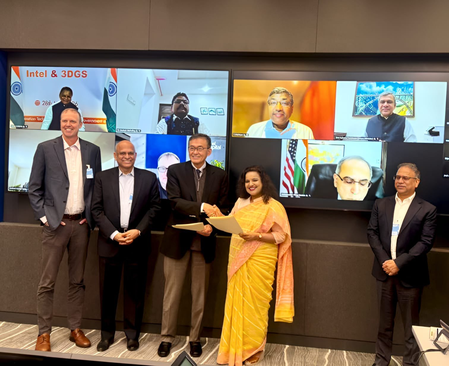
Bhubaneswar, May 29 (IANS) The Odisha government has signed a Memorandum of Understanding (MoU) with Intel and 3D Glass Solutions (3DGS) of the US for the establishment of an Advanced Packaging Substrate Manufacturing Facility in the state — a first-of-its-kind project in India, government officials said on Friday.
As per an official statement issued, the facility will leverage advanced glass-based substrate technologies and high-density interconnect packaging, essential for sectors such as AI, high-performance computing, telecommunications, and next-generation electronics.
Intel will serve as a technology partner, providing process expertise, technology licensing, quality systems, and workforce capability building.
Intel will serve as the technology partner for the project and will provide process expertise, technology licensing, quality systems, and workforce capability-building support.
The project, which will be implemented in phases, is expected to bring in an foreign direct investment (FDI) of nearly $3.3 billion, thereby significantly strengthening Odisha’s industrial base.
The proposed project, to be established in Bhubaneswar in Khordha district, will house world-class cleanrooms, fabrication units, testing infrastructure, and research and development (R&D) facilities.
This initiative positions Odisha at the forefront of the global semiconductor value chain, particularly in the field of advanced packaging, which is considered one of the most strategic and fast-evolving segments of the semiconductor industry.
By catalysing high-value industrial growth, innovation, and global integration, the project will directly contribute towards achieving Odisha’s ambitious target of becoming a $500 billion economy by 2036 and a $1.5 trillion economy by 2047.
The project will also facilitate the development of a comprehensive semiconductor ecosystem in the state, including advanced materials, specialty chemicals, glass substrates, capital equipment manufacturing in the upstream sector, electronics manufacturing, system integration, and export-oriented industries in downstream sectors.
It is further expected to drive cluster-based industrialisation by attracting global players and accelerating Odisha’s transformation into a semiconductor manufacturing hub.
The ambitious initiative will position Odisha as a centre for niche semiconductor technologies, including advanced packaging and materials engineering.
he project will also strengthen academia-industry partnerships and boost research and development, innovation, and skill development ecosystems in the state.
This, in turn, is expected to create a future-ready talent pipeline aligned with global semiconductor industry demands and Odisha’s long-term growth vision.
Nearly 1,800 direct high-skilled jobs, along with a significant number of indirect employment opportunities, are expected to be generated through the project.
The initiative will also promote a transition towards high-quality, knowledge-based employment generation, which has been identified as a key pillar under Odisha’s ‘Vision 2036’ roadmap.
The project is also expected to enhance GST collections and increase state revenues through manufacturing activities, ancillary industries, and supply chain development.
It will further strengthen Odisha’s long-term tax base and export earnings, thereby contributing to sustainable fiscal growth.
With the establishment of the facility, Odisha is expected to emerge as a leading destination for semiconductor and advanced electronics manufacturing in India.
The project will also integrate the state into global semiconductor supply chains, reinforcing Odisha’s strategic importance in the global economy.
“By attracting significant FDI, enabling semiconductor ecosystem development, creating high-quality jobs, and strengthening fiscal revenues, the project directly contributes to the state’s ambition of becoming a $500 billion economy by 2036 and $1.5 trillion by 2047,” an official statement said.
–IANS
gyan/khz