



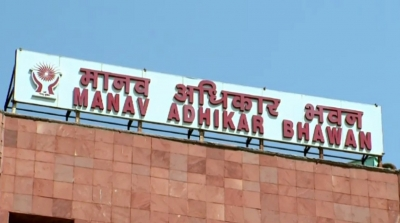
New Delhi, July 20 (IANS) The National Human Rights Commission (NHRC) has taken suo motu cognisance of reports alleging that girl students were frisked, beaten and forced to remove their clothes by teachers after one of them allegedly lost Rs 1,000 at a government school in Rajasthan’s Sawai Madhopur district.
Observing that the contents of the news report, if true, raise serious issues of violation of the human rights of the victim students, the apex human rights body has issued a notice to the Rajasthan Chief Secretary, seeking a detailed report within two weeks.
According to media reports, the incident occurred at the Government Senior Secondary School in Liwali village, where girl students of Classes IX and XI were allegedly subjected to frisking and forced to remove their clothes after a teacher reported that Rs 1,000 had gone missing.
The reports further claimed that the students were also beaten by two teachers during the search, though no money was recovered from them. According to reports, the students narrated the incident to their parents after returning home, following which a large number of parents gathered at the school the next day to protest.
Meanwhile, the Rajasthan School Education Department suspended senior teacher Saraswati Meena over the incident after a report submitted by the Chief Block Education Officer (CBEO).
The school’s vocational education instructor, Vandana Sharma, was also relieved of her duties and sent back to the service-providing agency.
The Rajasthan School Education Department had subsequently said it was monitoring schools to ensure student safety and had directed officials to strengthen oversight of educational institutions across the state.
Established under the Protection of Human Rights Act, 1993, the NHRC, an autonomous statutory body, is an embodiment of India’s concern for the promotion and protection of human rights. Its primary role is to protect and promote human rights, defined as the rights relating to life, liberty, equality, privacy and dignity of individuals guaranteed by the Constitution or embodied in international covenants and enforceable by courts in India.
–IANS
pds/uk