



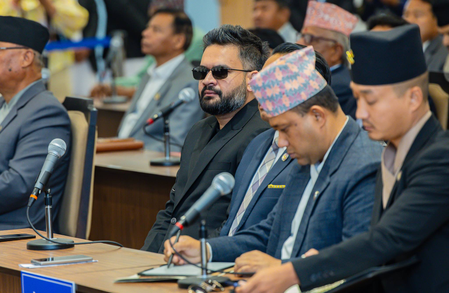
Kathmandu, March 2 (IANS) The arrest of former Prime Minister K P Sharma Oli and former Home Minister Ramesh Lekhak over the suppression of Gen-Z protests in September last year was hotly debated during the first meeting of the federal parliament held on Thursday, following the March 5 parliamentary elections.
Oli, chairperson of the Communist Party of Nepal (Unified Marxist–Leninist, CPN-UML), and Lekhak, a leader of the Nepali Congress, were arrested on March 28 in connection with a culpable homicide case linked to the suppression of protests in early September last year that left several demonstrators dead. During the uprising, as many as 77 people lost their lives, while public and private property worth over NPR 84 billion was damaged.
As leaders of the CPN-UML and Nepali Congress criticised the government over the arrests, Rabi Lamichhane, President of the ruling Rastriya Swatantra Party (RSP), defended the move, saying it served justice for the martyrs’ families. “The martyrs’ mothers deserve the first right to justice, and that should not be considered revenge,” Lamichhane said.
The RSP emerged as the largest party in the House of Representatives following the March 5 elections, securing 182 out of 275 seats while traditional political parties were thrashed.
Lamichhane stated that the ruling party would not pursue a campaign of revenge against opposition parties despite its numerical strength in parliament. “No one will be treated differently based on ideology anymore,” he said.
He added that laws had previously been amended to protect those in power and to implicate the opposition. “Such wrong practices will be corrected as soon as possible. There will be no place for arrogance and revenge against the opposition,” he said.
During the meeting, CPN-UML leaders criticised the arrest of Oli and Lekhak, arguing it was the part of a larger conspiracy. Parliamentary Party leader of UML Ram Bahadur Thapa ‘Badal’ questioned why they were arrested “illegally”, calling it part of a broader conspiracy.
He also blamed state machinery — including the Nepal Army, bureaucracy, and the previous government led by then Prime Minister Sushila Karki — as well as the activities of the Barbara Foundation, a non-governmental organisation, and the use of misinformation and disinformation through artificial intelligence, algorithms, and Goebbels-style propaganda for the RSP’s massive victory.
Nepali Congress lawmaker Bishma Raj Amdennge questioned the impartiality of the High-Level Commission, criticising the leaked report for its silence on the incidents of September 9, when public and private property was heavily damaged. During the two-day protest on September 8 and 9 last year, several people were killed in police shootings, while protestors damaged public and private properties massively in the following day.
“Why was the Parliament building reduced to ashes? Why was Singha Durbar, the main administrative center of Nepal’s government, burned? Who set them on fire?” he asked, stressing that the incidents of September 8 and 9 should be examined in detail, one by one.
During the forest meeting, the RSP President Lamichhane also sought forgiveness from the Dalit community for the discrimination they faced over centuries.
“I have something to say today to the Dalit community of this country, along with a public apology. This government is, for the first time, offering a collective and public apology — from this very House — for the centuries-long history of discrimination, injustice, and oppression,” he said. “On behalf of the entire party and the government, I apologise, and I want to ensure that the price of this apology will now be paid through justice.”
–IANS
scor/as