



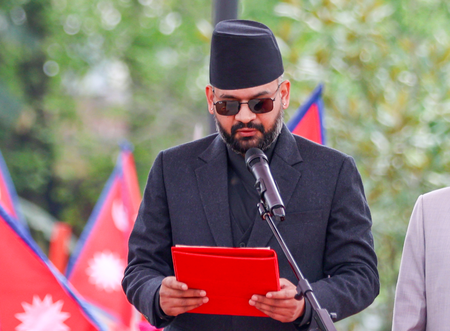
Kathmandu, June 1 (IANS) Nepal’s Ministry of Foreign Affairs has clarified that Prime Minister Balendra Shah’s remarks regarding the South Asian country also encroaching on Indian territory were related to “cross-border occupation” and encroachment in the no-man’s land along the border with India.
Prime Minister Shah on Sunday triggered a political storm after claiming, during his first-ever appearance to answer lawmakers’ questions in Parliament, that Nepal had also encroached on Indian territory despite Nepal’s consistent complaints about Indian encroachment.
Opposition political parties, foreign affairs experts, and border analysts heavily criticised Prime Minister Shah for the remarks, saying they undermined Nepal’s long-standing position on the border dispute with India and weakened Nepal’s stance in future negotiations with India on border issues.
In a statement issued on Sunday evening, the Nepali government said the Prime Minister’s comments were connected to technical studies conducted in border areas where citizens of one country have been using or occupying land that technically falls within the territory of the other country.
“The matter mentioned by the Prime Minister in Parliament was primarily related to encroachment in the no-man’s land area and cross-border occupation,” the statement said.
The Ministry noted that due to the “Fixed Boundary Principle” adopted in river boundary areas, situations have emerged in some places where Nepali citizens cultivate or reside on land technically located on the Indian side, while Indian citizens use land falling within Nepal’s territory.
The Foreign Ministry reiterated that Nepal’s official position regarding disputed border areas, including Limpiyadhura, Lipulekh and Kalapani, remains unchanged and that unresolved border issues would be addressed through diplomatic dialogue and mutual understanding with India.
According to the Ministry, technical committees and border mechanisms of the two countries are currently engaged in repairing border pillars, addressing encroachment in the no-man’s land, and collecting records of cross-border occupation in mapped areas along the frontier.
Nepal and India share a long and open border, much of which was defined by the 1816 Treaty of Sugauli. However, mapping remains incomplete in areas such as Susta and Limpiyadhura-Lipulekh-Kalapani.
A long-running border dispute has remained one of the key irritants in bilateral relations.
Though Nepal has consistently complained about Indian encroachment on Nepali land, Prime Minister Shah’s remarks appeared to suggest that encroachment has taken place from both sides. In fact, there is no known instance of India formally accusing Nepal of encroaching on Indian territory.
“After becoming Prime Minister, I came to know that not only has India encroached on Nepal’s land, but Nepal has also encroached on India’s land in multiple places,” Prime Minister Shah said earlier in Parliament.
“Both sides should sit down and look into the matter.”
However, he did not disclose any details about where Nepal had allegedly encroached on Indian land.
Leaders from opposition parties immediately demanded clarification on where Nepal had encroached on Indian territory. Some lawmakers even asked Speaker D.P. Aryal to remove the Prime Minister’s remarks from Parliament’s official record.
Replying to a separate question regarding the India-China agreement to allow Indian pilgrims to travel to Kailash Mansarovar through the disputed Lipulekh area, the Prime Minister said Nepal had already sent an official diplomatic note to India and received a response.
Shah said disputes over Lipulekh, Limpiyadhura and Kalapani would be resolved through diplomatic dialogue. He also shared some details about India’s response.
“The response states that both governments will form teams comprising historians, surveyors and experts familiar with the territory and seek a resolution through table talks,” PM Shah said.
He added that Nepal had also engaged in diplomatic discussions with China and the United Kingdom regarding the border dispute with India.
It is probably the first time Nepal has openly admitted holding talks with the UK regarding the Nepal–India border dispute.
“We have spoken not only with India and China but also with the UK government. Our view is that the UK should also take an interest, as the issue dates back to the period when the British controlled India,” PM Shah said.
–IANS
scor/ksk/khz/