

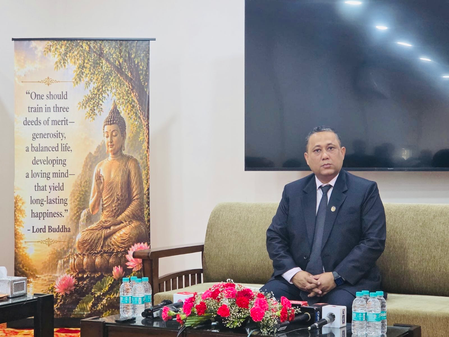
Kathmandu, June 12 (IANS) Just a week after returning from India, Nepal’s Foreign Minister Shishir Khanal is now set to pay an official visit to China from June 14 to 17, the two countries announced on Friday.
The foreign ministries of both countries said in separate statements that Khanal will undertake the four-day visit to Beijing at the invitation of Chinese Foreign Minister Wang Yi, who is also a member of the Political Bureau of the Communist Party of China Central Committee.
“Minister Khanal will hold bilateral talks with his Chinese counterpart Wang Yi in Beijing and discuss matters of mutual interest aimed at further strengthening Nepal-China relations and advancing deeper cooperation,” Nepal’s Foreign Ministry said. “He will also meet with high-level dignitaries of China.”
During the visit, Khanal will participate in an investment conference to be organised by the Nepali Embassy in Beijing to promote foreign investment in Nepal, where he will interact with members of the Chinese business community.
In recent years, China has emerged as one of the largest investors in Nepal. Chinese investors have committed the largest share of foreign direct investment (FDI) in Nepal in most years over the past decade, according to Nepal’s Department of Industry. However, in terms of accumulated FDI stock, India continues to lead due to the actual volume of investments realised in Nepal.
The foreign minister’s trip to Beijing comes shortly after his visit to New Delhi and at a time when Nepal’s new government, led by Prime Minister Balendra Shah, is seeking to maintain balanced relations with its two giant neighbours. Shah has repeatedly stated that his government will adhere to the longstanding principles of Nepal’s foreign policy.
In the annual budget for fiscal year 2026-27, the government said it would strengthen balanced foreign relations based on mutual benefit, national dignity and sovereign interests while mobilising soft power to promote economic prosperity.
“We will strengthen balanced foreign relations based on mutual benefit, national dignity and sovereign interests while mobilising soft power for economic prosperity,” the budget document states.
Experts say that this is also an opportunity for the new Nepali government to understand China’s thinking towards Nepal in the changed political context, and China would also like to understand the foreign policy of the newly emerged political force in Nepal – Rastriya Swatantra Party, which has formed an all-powerful government in the Himalayan country.
“At a time when China is concerned about how the new government will approach China-related issues, Foreign Minister Khanal’s visit will be important for Beijing to understand the new government’s position on China’s core interests,” former Nepali Ambassador to China, Bishnu Pukar Shrestha told IANS earlier.
“Tibet and Taiwan are two of China’s core security interests, and China will work with any government in Nepal that upholds the One-China policy,” he said.
Shrestha added that China would also like to see faster implementation of projects under the Belt and Road Initiative (BRI), as little progress has been made on identified BRI projects in Nepal.
“For Nepal, Chinese support in the areas of the three Cs — connectivity, communication and climate — is important,” he said.
Earlier, in its draft National Commitment Paper circulated for political consensus, the Nepali government said it would pursue a policy of maintaining “equal distance and equal proximity” with all countries, based on the belief that military alliances, arms races and wars undermine global peace.
In practice, Nepal maintains a multifaceted relationship with India because of shared geography, culture and religion. The two countries also enjoy close people-to-people ties, an open border and deep economic interdependence.
–IANS
scor/ksk/as