



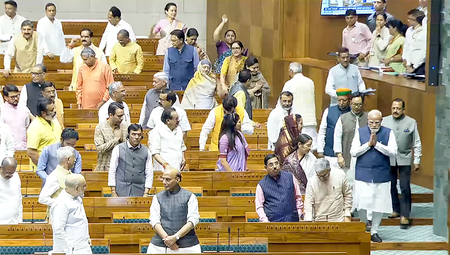
New Delhi, April 16 (IANS) The Union government on Thursday introduced and initiated discussion on the Constitution (One Hundred and Thirty-First Amendment) Bill, 2026, and the Delimitation Bill, even as Opposition members in the Lok Sabha pressed for a division before the move.
Out of 333 Lok Sabha MPs present, 207 voted in favour and 126 against the introduction of the Bill. This has triggered a high-stakes legislative showdown in the Lok Sabha as Parliament convened a three-day special session.
When the legislation is put to a vote after the debate, it will need approval by a majority of at least two-thirds of the members present and voting. Article 368 provides, except for certain provisions, for the amendment of the Constitution when the Bill is passed “by a majority of the total membership of that House and by a majority of not less than two-thirds of the members of that House present and voting”.
Subsequently, the President grants assent to the Bill.
The current strength of the Lok Sabha is 540, since three seats are vacant. This means that if all members are present and voting on Friday, at least 360 positive mandates are required for the Bill to pass.
The ruling National Democratic Alliance (NDA) currently holds around 292 seats in the Lok Sabha, giving it a working majority. The Opposition INDIA bloc and its allies hold about 229 seats, while other parties hold 12.
Additionally, seven independent MPs were elected to the Lok Sabha.
The Bharatiya Janata Party (BJP), with 240 members, is the principal constituent of the NDA, followed by the Telugu Desam Party with 16, and Janata Dal (United) at 12.
Among the Opposition bloc, parties with double-digit representation include the Congress at 98, the Samajwadi Party at 37, the Trinamool Congress at 28, and the Dravida Munnetra Kazhagam (DMK) at 22 seats.
Others include the Yuvajana Sramika Rythu Congress Party (YSRCP), the Aam Aadmi Party, and the All India Majlis-e-Ittehadul Muslimeen (AIMIM).
This numerical balance sets the stage for a fierce contest over the Constitution (One Hundred and Thirty-First Amendment) Bill, 2026, the Jammu & Kashmir Laws (Amendment) Bill, 2026, and the Delimitation Bill, 2026, all scheduled for voting in the ongoing special Parliament session.
The Bill is set to expand the Lok Sabha’s strength from 543 to 850 seats. It is linked to operationalising the 33 per cent women’s reservation law. While the women’s reservation law was passed in 2023, it has yet to be operationalised due to a linked fresh delimitation exercise.
The government is now looking to amend relevant provisions to pave the way for its rollout ahead of the 2029 Lok Sabha elections.
The Jammu & Kashmir Laws (Amendment) Bill, 2026, provides clarity for the assemblies of Delhi, Jammu & Kashmir, and Puducherry and aims to harmonise representation with the expanded Lok Sabha framework.
The Delimitation Bill, 2026, intends to redraw constituency boundaries to reflect population changes. The last Census was held in 2011, with the next scheduled for 2021, but postponed due to the COVID-19 pandemic.
The Opposition platform is united against delimitation, calling it an “attack on federalism” and warning of disproportionate gains for Hindi-speaking northern states. It is being strongly opposed by southern states like Tamil Nadu, Kerala, and Telangana, who fear reduced representation compared to northern states such as Uttar Pradesh and Bihar.
The NDA and INDIA bloc have been working out floor coordination plans to suit their own equations.
In his statement on the floor of the House, Prime Minister Narendra Modi mounted a strong defence of women’s quota. He countered Opposition charges, urging members not to give the issue a political colour.
“Those who oppose the women’s quota Bill will pay the price for a long time to come,” PM Modi said, adding that if all parties move forward together, the decision will not favour any one party but strengthen the country’s democracy.
–IANS
jb/dan