



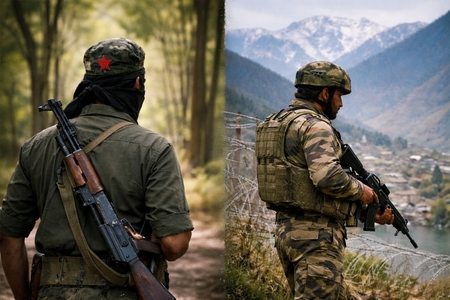
New Delhi, April 5 (IANS) India has recorded a significant decline in two of its most persistent internal security challenges — Left Wing Extremism (LWE) and militancy in Jammu and Kashmir — over the past 12 years, with sustained security operations, better intelligence coordination and development-led interventions playing a decisive role, according to a report.
On the Naxalism front, the report highlights a sharp contraction in both the geographical spread and operational capabilities of Maoist groups.
Once stretching across a wide “Red Corridor” covering parts of central and eastern India, Maoist influence is now largely confined to a limited number of districts.
Security forces have, over the years, neutralised several top Maoist leaders, dismantled key logistical networks, and choked supply lines that earlier enabled insurgents to operate with relative ease.
A major shift in strategy — from area of domination to intelligence-driven targeted operations — has been central to this success.
The increased use of technology, improved coordination between state police forces and central agencies, and the establishment of fortified security camps in remote areas have significantly reduced the mobility and strike capacity of Maoist cadres.
Equally important has been the government’s focus on development in LWE-affected regions.
Expansion of road networks, mobile connectivity, banking access and welfare schemes has helped integrate remote tribal areas into the mainstream, weakening the ideological and logistical support base of Maoist groups. Surrender and rehabilitation policies have also encouraged Maoist cadres to lay down arms, further accelerating the decline.
In Jammu and Kashmir, the report points to a steady weakening of militancy, particularly after a series of policy and security measures implemented over the past decade.
The security grid has been strengthened with better coordination among the Army, paramilitary forces and local police, leading to more frequent and precise counter-terror operations.
One of the defining aspects of the shift has been the focus on dismantling terror ecosystems, including overground worker (OGW) networks, financing channels and recruitment pipelines. Agencies have intensified surveillance and enforcement measures, making it increasingly difficult for militant outfits to sustain operations or attract new recruits.
According to the report by The Sunday Guardian, cross-border infiltration has been curtailed to a large extent due to enhanced border management, fencing and the use of advanced surveillance technologies. This has significantly impacted the ability of Pakistan-backed groups to replenish cadres and resources.
While local recruitment had emerged as a concern in earlier years, sustained pressure on militant leadership and outreach initiatives have contributed to a decline in fresh inductions.
At the same time, targeted operations have reduced the lifespan of active militants, limiting their operational impact.
The cumulative effect of these measures has been visible in the reduction of large-scale attacks and improved stability indicators in the region.
Civilian life, tourism and local governance have shown signs of revival, although the report cautions that sporadic incidents and residual threats remain.
The report authored by Abhinandan Mishra and published in The Sunday Guardian, concludes that the decline in both Naxalism and Kashmir militancy reflects a calibrated approach combining hard security measures with governance and development, leading to a gradual but sustained restoration of state authority in previously affected regions.
–IANS
sn/khz