

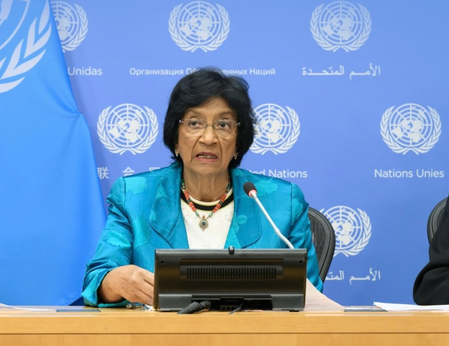
New Delhi, Oct 9 (IANS) South Africa’s High Commissioner to India, Anil Sooklal, on Friday hailed Indian-origin South African jurist Navanethem “Navi” Pillay, a former International Criminal Court judge, for winning the 2026 Nobel Peace Prize.
Pillay has become the fifth South African and the first South African woman to win the Nobel Peace Prize.
High Commissioner Sooklal highlighted that judge Navi Pillay joins Nelson Mandela, Archbishop Desmond Tutu, former African National Congress president Albert Luthuli, and former South African President F W de Klerk in the elite list of South Africans who have received the Peace Nobel.
“This sends a very powerful message about South African society, Africa, and the values of the rule of law. The prize recognises exceptional individuals who have dedicated their lives to serving humanity. Judge Pillay comes from the Tamil community. Her parents and great-grandparents left Tamil Nadu in the 1890s as indentured labourers to work on sugar plantations in South Africa,” the South African diplomat told IANS in an interview.
“I am particularly proud because she comes from the same area where I was born and raised, and she attended the same high school as I did. There is a great deal of celebration in our community today because she came from a humble and difficult background. The local community pooled its resources to support her education, and she has now risen to the highest levels of public service,” he added.
Hailing from a family of Indian Tamil descent in Durban, Pillay, 85, who became the first non-white woman judge of the High Court of South Africa, has been awarded the prize “for her efforts to promote peace and international law”.
Pillay has been at the forefront in the development of an international legal order, the Norwegian Nobel Committee, which selects the winner, said, according to the Nobel Prize website.
“During apartheid, she dedicated her life to the struggle for freedom. She became the first Black woman to open a law practice in KwaZulu-Natal and later served as a judge in South Africa’s High Court. She played an important role in defending anti-apartheid activists, including members of the African National Congress and other liberation movements. Her husband was also detained by the apartheid regime because of his activism,” High Commissioner Sooklal told IANS.
“Following South Africa’s transition to democracy, she went on to serve internationally, including at the International Criminal Tribunal for Rwanda, where she held a senior judicial position. She also served as a judge at The Hague and later as the UN High Commissioner for Human Rights. She has dedicated her life to the well-being of humanity and to creating a better world,” he mentioned.
The award, South African High Commissioner said, is particularly significant at this moment because it highlights the need to defend fundamental freedoms, human rights, and the principles of the UN Charter. In a world marked by divisions and violations of international law, the prize draws attention to Judge Pillay’s lifelong commitment to multilateralism, the United Nations, human rights and sends a “very important message” to the world.
“We are fortunate that South Africa now has five Nobel Peace Prize laureates. That is a significant number for a relatively young democracy that is just over three decades old. It is also recognition of the leadership South Africa has produced, not only in strengthening its own democracy and freedoms but also in working towards a better, more inclusive, and more just global society. This is not just about South Africa or the African continent. It demonstrates that exceptional leadership can emerge from Africa and the Global South, and in this case, from South Africa,” said Sooklal.
Pillay, who began her legal career by defending anti-apartheid activists and opened her own law firm in 1967, achieved another significant triumph in 1973 when she won a case for political prisoners on Robben Island, including Nelson Mandela, to have access to lawyers and some other basic rights.
Elevated to the High Court in 1995 after the end of the apartheid regime, Pillay, in 1999, became a judge and President of the International Criminal Tribunal for Rwanda (ICTR). Here, she stood by establishing, in the trial of Hutu leader Jean-Paul Akayesu, that rape and sexual violence would qualify as a war crime.
“I believe one reason the Nobel Committee may have chosen to honour Judge Pillay at this time is to highlight the need for collective action to address the divisions and fault lines in our world, particularly ongoing conflicts that claim innocent lives every day. The message being conveyed is one of peace, and that is the need of the hour. Conflicts, divisions, and unilateral actions by some countries that use their power to undermine the sovereignty of others remind us that we share a common humanity,” High Commissioner Sooklal told IANS.
–IANS
/as