



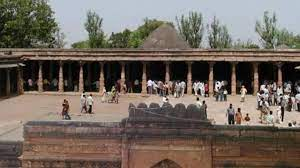
Indore, April 2 (IANS) The Madhya Pradesh High Court on Thursday fixed April 6 as the date to commence detailed regular hearings in the long-standing Bhojshala Temple-Kamal Maula Mosque dispute in Dhar district.
Due to paucity of time, as the division bench was scheduled to sit only till 1.30 p.m., the matter could not be taken up in detail on Thursday.
A division bench comprising Justice Vijay Kumar Shukla and Justice Alok Awasthi passed the order, stating clearly, “We fix all the matters for the hearing, and the hearing will commence from April 6, 2026, at 2.30 p.m.”
On March 16, the bench decided to personally inspect the disputed site. The Maulana Kamaluddin Welfare Society approached the Supreme Court seeking the production of video and photographs of the survey. On April 1, the Supreme Court observed that it did not doubt that the High Court would duly consider all objections raised by the parties, including those recorded during the ASI videography.
With the regular hearings now set to begin next week, the court is expected to examine the ASI findings, parties’ objections, and then decide the next course in this decades-old dispute.
The development is being closely watched across the state for its potential impact on communal harmony and heritage preservation.
The 11th-century monument, protected by the Archaeological Survey of India (ASI), is at the centre of a sensitive religious dispute. Hindus regard Bhojshala as an ancient temple dedicated to Goddess Vagdevi (Saraswati), while the Muslim community considers it the Kamal Maula Mosque.
Since 2003, the ASI has maintained an arrangement allowing Hindus to perform a ‘puja’ on Tuesdays and Muslims to offer namaz on Fridays.
In a significant step forward, the High Court on March 11, 2024, directed the ASI to conduct a comprehensive scientific survey using modern techniques to ascertain the true character of the site.
The survey was to be carried out by a committee of at least five senior-most ASI officers, accompanied by detailed photography and examination of locked or sealed areas within the complex.
The Supreme Court, while permitting the survey on April 1, 2024, had imposed restrictions, directing that no physical excavation altering the site’s character should take place and that no action be taken on the survey findings without its approval.
In January 2026, the apex court disposed of related matters and allowed the sealed ASI report to be opened and shared with all parties. Subsequently, the High Court asked all stakeholders to submit their objections and suggestions regarding the survey report.
–IANS
sktr/dpb