

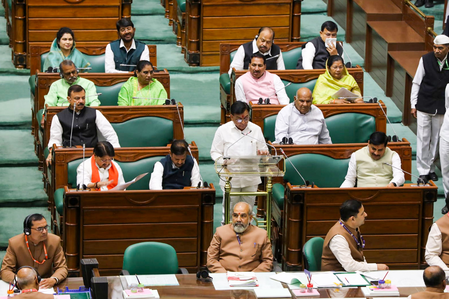
Bhopal, July 20 (IANS) In a latest development on the opening day of the Monsoon Session of the Madhya Pradesh Legislative Assembly on Monday, the state government introduced the much-anticipated Madhya Pradesh Uniform Civil Code (UCC) Bill. Higher Education Minister Gautam Tetwal tabled the bill in the House, triggering a massive uproar from opposition parties.
Chief Minister Mohan Yadav-led cabinet had given approval for the introduction of the Bill, terming it a “historic move” towards ensuring equality and uniformity in personal laws.
Along with the UCC Bill, a total of 14 bills were introduced, including the Dhanvantari University Bill, Fire Services Bill, Ease of Doing Business Bill, and Cess Amendment Bill.
Assembly Speaker Narendra Singh Tomar informed the House that these bills would be taken up for detailed discussion during the session. Details were provided in the “supplementary list of business.”
The UCC Bill seeks to bring uniform rules for marriage, divorce, adoption, and inheritance, replacing religion-specific personal laws. Key provisions include a ban on polygamy and ‘Triple Talaq’, mandatory registration of marriages and live-in relationships, and equal inheritance rights for sons, daughters, widows, widowers, and parents. Children born out of live-in relationships will be considered legitimate with inheritance rights.
The Bill also provides for maintenance rights to women in live-in relationships if abandoned and action against those who desert their parents. Marriages solemnised through traditional customs such as Saptapadi, Nikah, Anand Karaj, and Arya Samaj rites will remain valid.
However, the bill proposes to criminalise practices like Nikah Halala. Marriages solemnised through force, fraud, or concealment of facts may be declared voidable. Divorce can be sought on grounds including cruelty, adultery, desertion, and mental disorder, with provisions for mutual consent divorce after reconciliation efforts fail.
The Bill mandates transparent adoption processes and stipulates that a person convicted of murdering a property owner cannot inherit that property. It establishes a system of Registrars and a Registrar General for registration of marriages, divorces, and related matters, with penalties for false declarations or tampering with records.
Importantly, the tribal community has been exempted from the UCC.
The bill clarifies that it does not abolish religious marriage practices but creates a uniform legal framework for their consequences. The draft of the UCC Bill was prepared by a seven-member committee headed by former Supreme Court Justice (Retired) Ranjana Prakash Desai.
The committee was constituted on April 27, 2026, and gathered suggestions from over 10 lakh people through consultations and a web portal before finalising recommendations.
The government is calling it a major step towards social reform and gender justice. However, the opposition’s strong protest indicates that the Bill is likely to witness intense debate in the coming days.
–IANS
sktr/uk