



New Delhi, March 31 (IANS) Despite claiming limited resources, Maoist insurgents had successfully created a narrative over decades in favour of their “armed revolution against the state” which the NDA government now claims had the support of the then Congress regime, and part of the urban intelligentsia.
Through this time, it was believed that abject poverty in rural areas, especially among tribals, was among reasons for Maoism to flourish who reportedly extended a helping hand to those in need.
But data provided by Union Home Minister Amit Shah in his statement in Parliament on Monday destroyed that myth.
Facts and figures from the 1960s show Naxalbari had higher per capita income compared to non-affected regions like Saharsa in Bihar, proving the movement was driven by ideology rather than poverty, as he pointed out from documents.
The foundation for the doctrine of Communist China’s founding father was laid at Naxalbari, in the Siliguri subdivision of West Bengal’s Darjeeling district.
It was around Nepal’s Terai region that in 1967, radical Left leaders organised tribal peasants to rise against oppressive landlords to demand land rights.
Inspired by Mao Zedong’s “political power comes from the barrel of a gun” phrase, it sought to overthrow feudal structures and establish a more equitable system. But the real aim was to establish a “People’s Democratic Republic” through armed insurgency.
The uprising marked the beginning of a broader Maoist insurgency in India. Though suppressed, the uprising ignited similar movements across India, giving birth to the broader Naxalite insurgency.
As the Home Minister pointed out, the ‘Red Corridor’ spanned 12 States, covering 70 per cent of the country and affecting 20 crore citizens. During this period, over 20,000 lives were lost in the violence, which included more than 5,000 security personnel, he added.
Busting another myth – that the insurgents supported local economy – Shah stressed that investigations have revealed that the Naxals were collecting an annual “tax” of Rs. 240-crore from the public.
Those who have visited the affected areas during this time have also witnessed roads dug, large trees felled on ground, reportedly as defence against operations by security forces.
At the same time, these measures kept all attempts at development, welfare activities, and aid delivery by the state at bay.
Additionally, bomb blasts and intermittent armed surges on factories and areas marked for industries, spread terror. In fact, close to 92 per cent of weapons used by the Naxals were not imported, as the word was spread then, but looted from police stations and armories, according to the Home Minister.
To further spread their daring spirit and raise the fear factor, raids were conducted frequently. In 2005, 1,000 armed Naxals stormed a CRPF camp and a jail in Bihar’s Jehanabad, freeing 389 prisoners, Shah added.
Meanwhile, the National Advisory Council (NAC) and various town-based intellectuals – dubbed “Urban Naxals” – provided the insurgents both legal and policy cover.
Ironically, the NAC, an extra-constitutional advisory body, was established in 2004 to advise the Prime Minister on social, economic, and developmental policies that had Sonia Gandhi as its Chairperson. However, since the Prime Minister Narendra Modi-led government assumed power at the Centre in 2014, a mix of iron fist and velvet glove approach has led to India becoming Naxal-free “as of March 31, 2026, marking the end of a 56-year-old conflict,” asserted Shah.
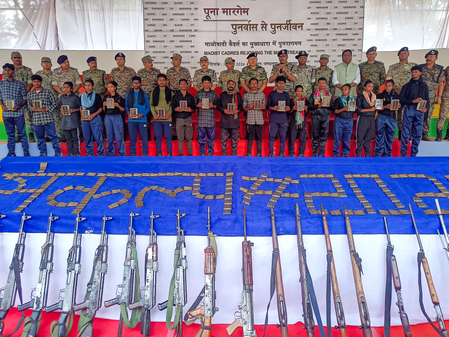
‘Affected’ districts dropped from 126 (in 2014) to just 2 (in 2026); ‘Most Affected’ districts fell from 35 to zero, while the entire top leadership were neutralised or surrendered. Meanwhile, a policy of zero-tolerance for “Urban Naxals” and a lucrative surrender policy, where surrendering Naxals receive Rs. 50,000 as immediate aid, monthly stipend for 36 months, education support for children till class 12, and housing under PM Awas Yojana – acted as the velvet glove.
As the Home Minister put it, the path from bullets to ballots lay through ‘goli ka jawab goli (bullet for bullet)’ and ‘development for all’ that restored the rule of law. Incidentally, the rewards are doubled for collective surrenders with Rs. 1 crore granted to any Panchayat that becomes Naxal-free.
Finally, it was the government’s intent, meticulous planning, and perfect execution that helped both the iron fist and the velvet glove to silence the gun aiming to disrupt democracy.
–IANS
jb/rad