



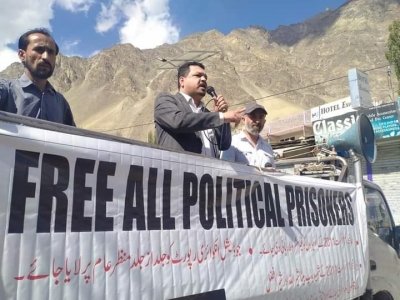
Islamabad, June 13 (IANS) Islamabad has long projected itself as the custodian of Kashmiri interests, yet developments in Pakistan-occupied Kashmir (PoK) sit uneasily with that narrative. A region promoted internationally as part of a national mission should not repeatedly witness coercive measures aimed at securing public obedience, a report has stated.
According to a report in ‘One World Outlook’, the unrest in PoK is more than a periodic flare-up; it exposes a political order built on “managed representation, coercive policing, and a long habit of treating local grievances as a security problem rather than a governance failure.”
What began as a dispute surrounding reserved assembly seats has transformed into a larger question about whether the region’s inhabitants are treated as people with legitimate rights or as subjects expected to comply without dissent.
The report noted that the current crisis is not an isolated episode but the culmination of longstanding failures of authorities in PoK to ensure affordable essential services, responsive governance, and meaningful political representation.
The move against the Joint Awami Action Committee (JAAC), it said, is particularly revealing, as it reflects an effort to suppress a protest movement rather than address the grievances underpinning it.
“Banning a protest movement does not solve its grievances; it only narrows the space for peaceful bargaining and raises the political cost of compromise,” the report added.
It further argued that when demands around “price relief, governance reform, and opposition to reserved-seat manipulation” are framed as a “security threat”, the authorities signal that they have “no better answer than force”.
The report highlighted that local activists maintain that the seats are used by Pakistan’s mainstream parties to shape the political landscape, thereby diminishing the influence of local inhabitants over their own affairs.
“That complaint should not be dismissed as narrow factionalism. A legislature that is partly shaped by political actors outside the territory is not fully accountable to the people who bear the consequences of its decisions. If the region’s residents believe that their assembly is an instrument for external influence, then every policy failure, every subsidy shortfall, and every policing excess will be interpreted through the lens of captured institutions,” it mentioned.
The report stated that the “recurring flashpoints” in PoK are not abstract constitutional disputes but the everyday economics of survival.
It highlighted that “flour and electricity” — the essentials of daily life — have repeatedly become sources of public anger as authorities struggle to provide them at prices ordinary residents can afford.
When authorities are forced to extend emergency relief after deadly protests, it is effectively admitting that their earlier approach was “unsustainable”.
“This is the classic authoritarian bargain in miniature: cheap legitimacy through selective patronage, followed by coercion when the bill comes due. Protesters may be imperfect, sometimes unruly and at times violent, but the underlying grievance is legitimate when an impoverished population sees elite privilege protected while its own cost of living rises. That is why these episodes recur,” the report stressed.
–IANS
scor/as