



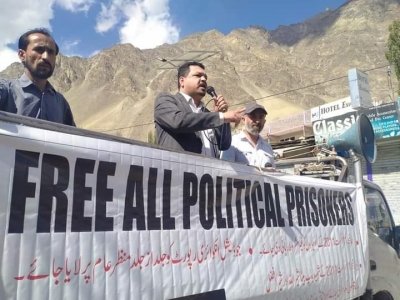
Athens, Oct 10 (IANS) The manipulation of the so-called legislative elections in Pakistan-occupied Kashmir (PoK) is yet another reflection of Pakistan’s deeply flawed democratic system, a report has stated.
It noted that historically, Pakistan has struggled to ensure free and fair elections, meaningful parliamentary proceedings and credible legislative lawmaking.
The legitimacy of the recent PoK elections, held amid a popular uprising, has been widely questioned, with some of the strongest criticism coming from within Pakistan itself, according to a report in Athens-based ‘Directus’,
Citing a Human Rights Commission of Pakistan (HRCP) fact-finding report, it highlighted grave concerns over allegations of lethal and excessive force used by Pakistani authorities against protesters during the recent PoK unrest, which was triggered by longstanding political and socio economic grievances.
Despite being unable to reach Rawalakot, a major hotspot of the violence, the HRCP mission received multiple accounts from families who alleged that protesters were killed or seriously injured by security forces, the report mentioned.
“Raising concerns at the government’s use of anti-terrorism and preventive-detention provisions against political activists, HRCP’s report questions whether the use of force by the forces was lawful, necessary and proportionate. The report expresses alarm over the government’s use of anti-terrorism and preventive-detention provisions against political activists,” it noted.
The findings revealed that at least 147 Joint Awami Action Committee (JAAC) activists were initially placed on the Fourth Schedule of Pakistan’s Anti-Terrorism Act, with a series of notifications issued between June and August reportedly taking the total number of political workers, journalists, residents and activists listed under anti-terrorism laws to at least 157, the report detailed.
Casting doubt on the credibility of the electoral process, it said, the HRCP mission questioned the heavy deployment of security personnel, prolonged communication restrictions and curbs on independent observation in PoK.
“Democratic erosion is a gradual process that has been an ongoing process in Pakistan. Historically, Pakistan’s democratic development has been interrupted by the military essentially taking over the government. Although a formal sense of military rule ended in 2008, it left the system fractured and without a sense of structure for a democracy,” Directus stated.
The report noted that Pakistan’s drift towards authoritarianism is rooted largely in its long history of military intervention and control.
In a recent podcast titled “Beyond the Indus”, Ayesha Siddiqa, a senior fellow in the Department of War Studies at King’s College London and author of ‘Military Inc’, described Pakistan not as a hybrid regime but as a case of constitutional militarism.
“The legal framework which allows the system where the military has greater say, or complete control, almost complete control, has been condoned and supported by the Parliament itself. The Parliament is still there. Technically, Pakistan has elections. It is going to have the next elections in 2029. But do we have a decision-making system where civilians have a say? The answer is no,” Directus quoted Siddiqa as saying.
–IANS
scor/as