



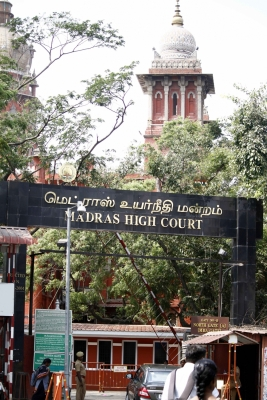
Chennai, Sep 16 (IANS) The Madras High Court on Wednesday questioned the practice of elected legislators resigning their seats, joining another political party and contesting the consequent bypolls from the same constituency, observing that such conduct could insult voters and their original mandate.
Justice S.M. Subramaniam said an MLA who resigns only to seek re-election on another party’s ticket may be making a mockery of democracy.
He asked why the Election Commission of India (ECI) should not study the issue and formulate appropriate guidelines by invoking its powers under Article 324 of the Constitution.
The observations were made by the court’s second Division Bench, comprising Justice Subramaniam and Justice K. Govindarajan, while hearing a public interest litigation (PIL) filed by Chennai advocate K. Suthan.
The petitioner sought measures to prevent elected representatives from resigning after switching parties and then contesting the resulting bye-election from the same seat. He argued that the practice undermined the choice made by voters during the general election and imposed an avoidable financial burden on the public.
Senior counsel R. Singaravelan, appearing for the petitioner, informed the Bench that six AIADMK legislators in Tamil Nadu had resigned after this year’s Assembly election and subsequently joined the ruling Tamilaga Vettri Kazhagam. Of them, Maragatham Kumaravel and P. Sathyabama have been fielded by the TVK in Madurantakam and Dharapuram, respectively.
The vacancies in both constituencies had arisen following their own resignations.
The court was told that the Election Commission had notified bye-elections only for these two seats and not for the other constituencies vacated by the remaining legislators.
Singaravelan contended that allowing elected representatives to resign and immediately return to the electorate under another party’s banner, without restrictions, weakened democratic accountability.
Voters who had elected a candidate based on a particular party affiliation were being compelled to vote again because of the legislator’s political decision, he submitted.
He warned that failure to regulate the practice could encourage mass resignations in the future, resulting in repeated bye-elections and causing a substantial loss to the public exchequer.
The Bench indicated that the issue required closer examination because of the Election Commission’s constitutional responsibility to supervise elections. It asked the poll body to consider whether safeguards could be framed to discourage resignations motivated solely by party switching and immediate re-election.
–IANS
aal/dpb