



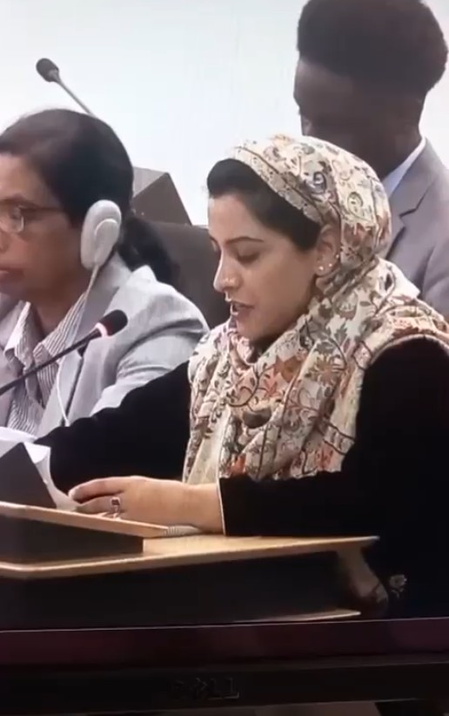
Geneva, Sep 23 (IANS) Socio-political activist Tasleema Akhtar slammed Pakistan over the brutal crackdown of protesters in Pakistan-occupied Jammu and Kashmir (PoJK) during the 63rd session of the United Nations Human Rights Council (UNHRC).
At the UNHRC session, Akhtar said that people recently held protests led by the Joint Awami Action Committee (JAAC) in PoJK over governance and economic issues and Pakistani authorities arrested hundreds of JAAC activists and supporters, suspended internet services, even as violent clashes were reported in the region.
“Pakistan-occupied Jammu and Kashmir has recently witnessed a sustained peaceful protest led by the Joint Awami Action Committee and other civil society groups over governance and economic issues. The brutal crackdown by the Pakistan government that followed resulted in the arrest of hundreds of activists and supporters, detention of key leaders, internet shutdown and violent clashes that claimed dozens of lives, underscoring continuing political instability and public discontent.”
Highlighting the lack of civic space in PoJK, the Kashmiri woman said: “There is a lack of civic space in POJK besides cases of large-scale reprisals, which require to be addressed. The ongoing killing of innocent civilians by Pakistani security forces in PoJK needs to be stopped at once with immediate protective measures.”
She demanded restoration of civic space and communication in PoJK with immediate intervention through UNHRC. She also called for a probe into each killing “with free and fair access to information related to all cases.”
Highlighting the development story of Jammu and Kashmir, Akhtar said: “In contrast, Jammu and Kashmir in India has advanced through skill development since 2024, generating employment and boosting local business. Smart city initiatives and rural infrastructure have further strengthened development.”
In recent months, PoJK has witnessed the most extensive confrontation between the local population and the Pakistani state in decades, with deadly violence, suspension of the internet, and allegations of police brutality. The protests led by the JAAC, which initially began over increasing prices of electricity and essential commodities, transformed into a movement calling for political reforms, greater accountability, and representative government.
–IANS
akl/vd