



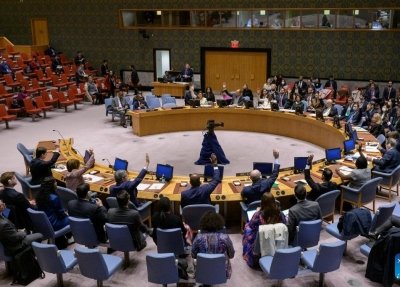
United Nations, June 4 (IANS) In a contentious race to succeed Pakistan for a seat earmarked for the Asia Pacific region on the UN Security Council, Kyrgyzstan has defeated the Philippines after four rounds of voting.
To be elected, countries have to get a two-thirds majority.
In elections held in the General Assembly on Wednesday, Portugal and Austria defeated the European powerhouse, Germany, for the two Western European seats.
With the combination of votes for the two seats, Portugal received 134 votes, and Austria 131, while Germany was eliminated with 104 votes.
Germany is a member, with India, Brazil, and Japan, of the G4, the group that works together for reforming the Council by adding permanent seats and mutually supports each other for them.
Germany faced intensive lobbying against it, led by Moscow, because of its strong opposition to Russia’s invasion of Ukraine.
German Foreign Minister Johann Wadephul cited his country’s “rock-solid support for Ukraine” and said: “It is no secret that Russia does not want such a voice at the Security Council”.
Another factor, he added, may have been Germany’s support for Israel.
The Western Europe group’s Denmark and Greece will complete their two-year terms at the end of this year.
The election for the Asia-Pacific seat went into high drama as Kyrgyzstan and the Philippines battled through four rounds for the two-thirds majority.
In the first round, Kyrgyzstan got 105 votes, and the Philippines 85, and the margin widened before it reached 142 to 49 in the fourth round, giving Bishkek its first term on the Council.
The election brought to the fore the divisions in the UN, where intensive lobbying raised the level of rivalries in the two important regions, Western Europe and the Asia-Pacific.
However, the elections for the other two regions, Africa and Latin America and the Caribbean, went off with no rivalries.
Zimbabwe was elected to the African seat, and Trinidad and Tobago to the Latin American and Caribbean seat, with the backing of their regional groups after a pro forma election in which Guyana tallied a single vote.
The winners succeed Somalia and Panama.
In addition to the five permanent seats, the Council has ten regionally distributed elected seats to which countries are elected to two-year terms on a rotating basis.
External Affairs Minister S. Jaishankar, in a post on X, congratulated the Foreign Ministers of the five countries that were elected.
The other five elected members, Bahrain, Colombia, the Democratic Republic of the Congo, Latvia, and Liberia, elected last year, will continue through next year on the Council.
–IANS
al/vd