



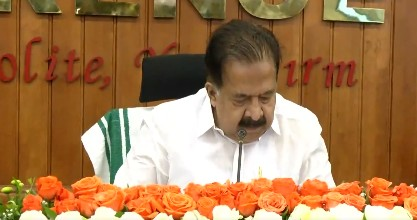
Thiruvananthapuram, May 26 (IANS) State Home and Vigilance Minister Ramesh Chennithala on Tuesday announced an ambitious anti-corruption initiative, ‘Project Zero’, aimed at building a corruption-free Kerala.
The announcement came after a high-level meeting of top officials of the Vigilance and Anti-Corruption Bureau held in Thiruvananthapuram.
“Project Zero — together let us build a corruption-free State. We will work closely with the people themselves,” Chennithala told reporters after the meeting, underlining that public participation would be the backbone of the campaign.
Appealing to citizens to actively cooperate with vigilance authorities, the Minister said people should come forward with information regarding corrupt officials and assured that complete secrecy and protection would be maintained for informants.
“If governance has to improve, it must become corruption-free. Our ultimate aim is to ensure that no citizen should have to grease the palms of officials for getting things done,” he said.
Stating that corruption had deeply eroded public confidence in the system, Chennithala said there was a growing perception among people that nothing moved without paying bribes. “That mindset has to change. If Kerala wants to become corruption-free, the people too must stand with us,” he said.
The Minister described Project Zero as a revolutionary concept that would focus more on preventing corruption before it takes place rather than merely initiating action after offences are committed.
He said the Vigilance and Anti-Corruption Bureau’s watchful eyes would remain on officials as well as those in public life and expressed confidence that the initiative would act as a major deterrent against corruption.
Chennithala also announced a major overhaul of the vigilance administration machinery, revealing that the decades-old 1969 Vigilance Manual was being completely rewritten.
The first draft of the revised manual, he said, was already ready for scrutiny.
At the same time, the Minister pointed to legal hurdles in corruption cases, particularly provisions in the amended Prevention of Corruption Act requiring prior sanction for prosecution against officials.
“That delay affects speedy action. I myself have approached the Supreme Court on the issue,” Chennithala said, while stressing that the government was committed to strengthening the anti-corruption framework in the State.
–IANS
sg/skp