



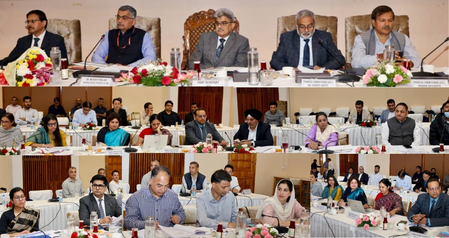
Srinagar, Oct 3 (IANS) J&K Chief Secretary Atal Dulloo and Additional Secretary (Foreigners & J&K), Union Ministry of Home Affairs, Nitesh Vyas, on Saturday jointly chaired a high-level meeting to review the implementation of various Centrally Sponsored Schemes (CSS) and the progress of ongoing developmental projects across Jammu and Kashmir.
Speaking during the meeting, the Chief Secretary stressed the need for a focused and outcome-oriented approach towards the implementation of Centrally Sponsored Schemes and flagship programmes in Jammu and Kashmir.
He emphasised that the objective should not only be to achieve physical targets but also to ensure that the infrastructure and services created under these programmes deliver sustained and measurable benefits to the people.
The Chief Secretary directed the concerned departments to accord priority to the time-bound completion of ongoing projects, effective utilisation of funds, and saturation of eligible beneficiaries under various welfare and development schemes.
He emphasised the importance of regular field-level monitoring and periodic assessment of outcomes so that gaps in implementation are identified at an early stage, and corrective measures are taken promptly.
Addressing the officers during the meeting, the Additional Secretary, MHA, emphasised the importance of timely implementation, effective inter-departmental coordination, optimal utilisation of resources, and regular monitoring of Centrally Sponsored Schemes and flagship programmes.
He stressed the need to address implementation bottlenecks and ensure that the benefits of various government initiatives reach the intended beneficiaries in a timely and effective manner.
Nitesh Vyas called upon the concerned departments and implementing agencies to maintain close coordination with the respective Ministries of the Government of India and ensure the timely resolution of issues affecting implementation.
The Additional Secretary, MHA, also laid emphasis on strengthening convergence among concerned departments and implementing agencies, improving project execution, and ensuring measurable outcomes from the various development and welfare programmes being implemented across Jammu and Kashmir.
During the meeting, a comprehensive review of the progress of various CSS, development projects and other welfare initiatives of the Union Government being implemented across Jammu and Kashmir was held.
A detailed PowerPoint presentation was also delivered on the occasion, covering Samagra Shiksha and PM SHRI Schools, including phase-wise selection, comparative assessment of schools and infrastructure status.
The progress of skilling initiatives under the Pradhan Mantri Kaushal Vikas Yojana (PMKVY) and preparedness for PM-SETU were also reviewed.
The meeting also undertook a detailed review of the PM Surya Ghar-Muft Bijli Yojana, with a focus on the installation of rooftop solar systems at households and the solarisation of government buildings.
Progress in the installation of smart meters, augmentation and upgradation of power infrastructure, connectivity infrastructure, and projects under the Revamped Distribution Sector Scheme (RDSS) was also discussed.
The progress of BharatNet Phase III was reviewed, with emphasis on strengthening digital connectivity and expanding broadband infrastructure.
Under the social sector, the progress of major social security and welfare schemes was reviewed, including Pradhan Mantri Jan Dhan Yojana (PMJDY), Pradhan Mantri Jeevan Jyoti Bima Yojana (PMJJBY), Pradhan Mantri Matru Vandana Yojana (PMMVY), and enrolment under maternity benefit schemes.
The implementation of POSHAN 2.0, nutritional profiles, workforce vacancies, and key indicators relating to Saksham Anganwadi were also discussed.
The progress under AMRUT 2.0 was reviewed, with discussions focusing on the status of ongoing projects, works undertaken, and their physical and financial progress.
The meeting also reviewed urban housing and sanitation initiatives under Pradhan Mantri Awas Yojana-Urban (PMAY-U) and Swachh Bharat Mission-Urban (SBM-U), including the implementation of PMAY-U 1.0 and PMAY-U 2.0.
The health sector review covered Ayushman Bharat Digital Health, Ayushman Arogya Mandirs, Pradhan Mantri Jan Arogya Yojana (PM-JAY), National Health Mission (NHM), and TB Mukt Bharat.
Discussions included targets and progress towards TB elimination and strategies for achieving the desired outcomes.
The National AYUSH Mission was also reviewed.
The meeting further reviewed rural housing and financing, including financial utilisation and the status of delivery under Pradhan Mantri Awas Yojana-Gramin (PMAY-G).
The review focused on progress achieved, utilisation of funds, and the timely completion of housing interventions for eligible rural beneficiaries.
In the tourism sector, the progress of projects under Swadesh Darshan 2.0 and key components of the scheme was discussed.
The meeting also reviewed green mobility and civil aviation infrastructure, including electric mobility initiatives and projects under FAME and PM e-Bus initiatives.
A detailed review was also undertaken regarding the implementation of Swadesh Darshan 1.0/2.0, PRASHAD (Pilgrimage Rejuvenation and Spiritual, Heritage Augmentation Drive), and the India Infrastructure Project Development Fund (IIPDF), with emphasis on the progress of projects and infrastructure development.
The meeting also reviewed the implementation of Pradhan Mantri Matsya Sampada Yojana (PMMSY) and the Fisheries and Aquaculture Infrastructure Development Fund (FIDF).
Discussions focused on strengthening fisheries and aquaculture infrastructure, enhancing fish production and productivity, improving post-harvest management and market linkages, and creating sustainable livelihood opportunities for fishers, fish farmers, and other stakeholders associated with the fisheries sector.
During the meeting, the Swachh Bharat Mission (Gramin) was discussed, with emphasis laid on improving sanitation and hygiene in rural areas.
The mission aims to sustain Open Defecation Free (ODF) status in villages and promote improved standards of cleanliness, sanitation and waste management.
The discussion covered continued efforts towards solid and liquid waste management, including effective management of household waste, plastic waste, greywater and other forms of rural waste.
Emphasis was also placed on ensuring that sanitation infrastructure created under the mission is properly maintained and remains functional.
While reviewing the implementation of the Jal Jeevan Mission (JJM), the focus was laid on providing adequate, reliable, and sustainable drinking water supply to rural households through functional household tap connections.
The review covered the status of water supply infrastructure, functionality of household tap connections, operation and maintenance of schemes, water quality monitoring, and the sustainability of drinking water sources.
Water transport and the development of inland waterways under the Ministry of Ports, Shipping and Waterways were also discussed.
The potential of waterways as an alternative mode of transportation for passengers and goods was highlighted.
The discussion covered the development of supporting infrastructure, including terminals, jetties and navigational facilities, wherever feasible, besides strengthening connectivity and exploring the potential of inland water transport for enhancing mobility and economic activity.
Later, in another meeting, the Chief Secretary and Additional Secretary, MHA, also held a comprehensive review of the implementation of the new criminal laws as well as the new legal framework related to immigration and foreigners management across Jammu and Kashmir.
–IANS
sq/dan