



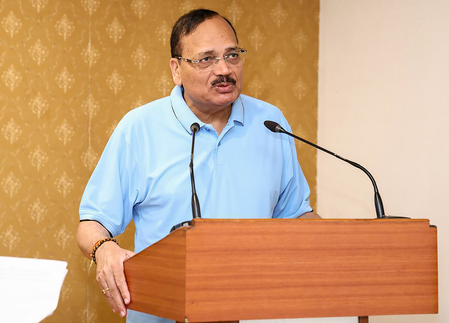
Jaipur, July 29 (IANS) Rajasthan’s capital Jaipur is set to become the global centre of judicial dialogue as delegates from all 52 Commonwealth nations gather for the Commonwealth Peace Mediation and Rule of Law Conference from July 31 to August 2.
The three-day summit is expected to culminate in the adoption of the landmark ‘Jaipur Peace Mediation Declaration’, a first-of-its-kind framework aimed at promoting peaceful dispute resolution and strengthening the rule of law across Commonwealth countries.
Hosted by the Rajasthan State Legal Services Authority, the conference will bring together judges, senior advocates, mediators, legal scholars, policymakers and justice experts from across the Commonwealth.
Around 30 countries have already confirmed participation, while organisers expect representation from most of the 52 member nations. The formal inauguration will take place on the evening of July 31 at Hotel The Lalit in Jaipur.
Among those expected to attend the inaugural session are Chief Justice of India Surya Kant, other Supreme Court judges, Rajasthan Chief Minister Bhajanlal Sharma, Acting Chief Justice of the Rajasthan High Court Justice Sanjeev Prakash Sharma, Attorney General R. Venkataramani, Supreme Court Bar Association President Vikas Singh and several other dignitaries.
Foreign judges who have confirmed their participation include Justice Daba Nair Patel of the Supreme Court of Zambia, Justice A.H.M. Nawaz of the Supreme Court of Sri Lanka, and Justice Vashisht V. Okara of the Court of Appeal of the Bahamas.
Jurists and legal experts from countries including the Bahamas, Zambia, Sri Lanka, Singapore, Zimbabwe, Hong Kong, the United Kingdom, Malaysia, Bangladesh, Eswatini, Kenya and the Maldives are also expected to participate.
The Ministry of External Affairs and the Ministry of Home Affairs have extended significant support for organising the conference.
Speaking to IANS, Rajasthan State Legal Services Authority officials said the conference’s most significant and historic outcome would be the ‘Jaipur Peace Mediation Declaration’, which will be signed by judges, senior advocates, attorneys, mediators and legal experts from Commonwealth nations.
The declaration aims not only to promote mediation but also to establish shared principles on conflict resolution, peace mediation, the rule of law and speedy access to justice across Commonwealth countries.
Organisers believe the document could become an important reference for future international judicial cooperation.
Officials said the conference is not merely intended as a platform for learning from other countries. Rajasthan’s experience in resolving a large number of disputes through mediation within a short period has created a model that could benefit other jurisdictions as well.
“The conference will serve as a platform for a two-way dialogue. India will learn from the world while also sharing its own successful mediation model,” organisers said.
Explaining the significance of the event for the public, Pawan Kumar Jeenwal, Secretary of the Jaipur District Legal Services Authority, told IANS that if the ideas discussed at the conference are implemented effectively, ordinary citizens would benefit through quicker resolution of disputes that might otherwise remain pending in courts for years.
He said wider adoption of mediation would reduce judicial backlog, lower litigation costs, save time and promote lasting peace between disputing parties instead of merely settling legal disputes.
Officials described the conference as more than an international gathering, calling it an opportunity for the Indian judicial system to demonstrate global leadership. They said if the Jaipur Peace Mediation Declaration achieves its objectives, it could become a historic document that reshapes mediation and dispute resolution across Commonwealth nations.
“For Rajasthan, this is not just an event but an opportunity to establish a strong presence on the global judicial map,” officials said.
The conference will deliberate on questions such as whether court cases that often take years can instead be resolved within days or weeks, whether mediation can eliminate not only disputes but also the bitterness that accompanies them, and whether a new global model of mediation can emerge from Jaipur.
“This is just the beginning of a new way of thinking, a new direction and a fresh global perspective within the justice system,” RSLSA officials told IANS.
Dr Hariom Attri, Member Secretary of the Rajasthan State Legal Services Authority, said the Commonwealth comprises countries whose legal systems have historically evolved from the British Common Law tradition, resulting in substantial similarities in both procedural and substantive laws.
He said there has long been a need for a common platform to discuss judicial reforms, alternative dispute resolution and the rule of law. With this objective, the Commonwealth Peace Mediation and Rule of Law Conference is being organised in Jaipur for the first time, with invitations extended to all 52 Commonwealth nations.
According to Dr Attri, nearly 30 countries have already confirmed participation, and organisers expect representatives from most Commonwealth members by the time the conference begins.
Explaining why Rajasthan was chosen to host the event, he said the decision reflects the state’s nationally recognised achievements in mediation. Under the Supreme Court’s Mediation Mission, Rajasthan resolved nearly 25,000 disputes through mediation, established a network of more than 2,000 trained mediators and promoted a culture of out-of-court dispute resolution.
Organisers said Rajasthan was selected because of its successful implementation of mediation initiatives launched by the Supreme Court and the state’s outstanding results.
A key feature of the conference will be its emphasis on ‘Peace Mediation’, which goes beyond conventional mediation by seeking to resolve not only legal disputes but also mistrust, bitterness and emotional discord between parties. The proposed Jaipur Peace Mediation Declaration is expected to provide a roadmap for Commonwealth nations to adopt mediation practices focused on long-term reconciliation rather than temporary settlements.
The conference will also focus extensively on strengthening the rule of law, judicial accountability, access to justice and constitutional values. Participants will discuss ways to make judicial institutions more accountable, improve justice delivery, reduce court pendency and promote alternative dispute resolution mechanisms across Commonwealth jurisdictions.
Dr Hariom Attri said Rajasthan earned the opportunity to host the conference because of its exceptional record in promoting mediation. Besides resolving nearly 25,000 disputes under the Supreme Court’s Mediation Mission, the state developed a network of over 2,000 trained mediators, significantly reducing litigation through out-of-court settlements.
Organisers believe the Jaipur Peace Mediation Declaration could emerge as one of the most significant judicial initiatives in the Commonwealth, positioning India at the forefront of shaping a global agenda for peaceful dispute resolution and justice reforms.
–IANS
arc/rad