

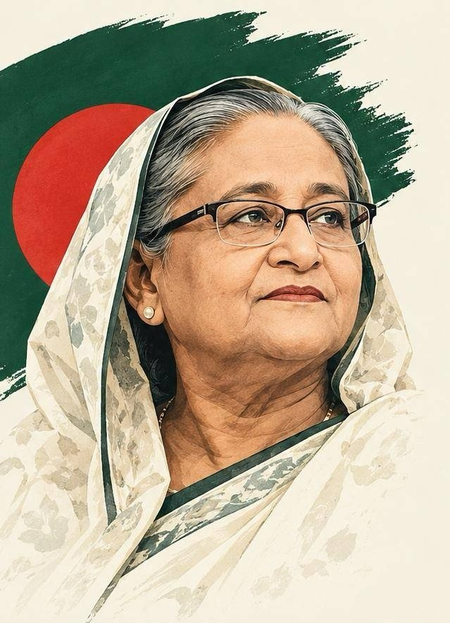
New Delhi, Nov 13 (IANS) Vowing to return home soon from a self-imposed exile since August 2024, Bangladesh’s former Prime Minister Sheikh Hasina on Friday said that she has considered all possibilities, including arrest, imprisonment and even a death sentence. In an exclusive interview with IANS, the deposed Awami League leader made it clear that she cannot stay away from home when ordinary people in Bangladesh are suffering and families are losing their homes along with livelihoods.
“I stopped worrying about my personal safety a long time ago. I returned to Bangladesh in 1981, despite military rule. I returned again in 2007, knowing that the military-backed government might arrest me. I have faced imprisonment and repeated attempts on my life. Fear has never stopped me from doing what I believe is right,” Hasina told IANS in a rare audio interview since she left Dhaka in August 2024.
The 79-year-old daughter of Bangladesh’s founding father Sheikh Mujibur Rahman also spoke about India-Bangladesh ties, growing attacks on minorities in Bangladesh, the allegations levelled against her and Dhaka’s growing closeness to China.
Excerpts:
IANS: You remain committed to returning home by December. Your resolve is strong but do you really see it happening, given the current circumstances in Bangladesh and personal risks involved?
Sheikh Hasina: Look, I understand the risks very well. I may be arrested the moment I arrive. They may send me to prison. They may even try to kill me. I have considered all these possibilities. But, you know, I stopped worrying about my personal safety a long time ago. I returned to Bangladesh in 1981, despite military rule. I returned again in 2007, knowing that the military-backed government might arrest me. I have faced imprisonment and repeated attempts on my life. Fear has never stopped me from doing what I believe is right. Today, my country is going through a terrible time. Our leaders and workers are being persecuted. Ordinary people are suffering, and families are losing their homes and livelihoods. How can I stay away while my people face such hardship? I have spent my entire political life with the people of Bangladesh. Whatever happens to me, I want to stand beside them. If I have to die, I would rather die on the soil of my own country, among my own people.
IANS: What do you have to say about all the allegations levelled against you, including the judicial enquiry and tribunal proceedings?
Sheikh Hasina: Let me make one thing very clear. I never ordered the killing of innocent people. I reject that accusation completely. Every death was tragic. As Prime Minister, I had a responsibility to protect the lives of our citizens, and I wanted to know exactly what had happened. That is why, on July 18, 2024, I established a Judicial Enquiry Commission headed by a High Court judge. On August 1, I expanded it into a three-member commission so that every incident could be examined properly. But what happened after Muhammad Yunus assumed power? He stopped that investigation. His administration subsequently granted legal protection to participants in the uprising for acts classified as political resistance. At the same time, murder cases were brought against me and thousands of Awami League leaders, activists and workers. If they really wanted the truth, why did they stop the judicial investigation that I had already established? Why should there be different standards of justice depending on someone’s political identity? As for the tribunal, I reject both the proceedings and the verdict. I was denied what I consider a genuine opportunity to defend myself. I will examine whatever lawful options are available to challenge that verdict.
IANS: The current government in Dhaka has been pressing for your extradition but India has maintained it is a legal matter and the issue will be dealt with accordingly…
Sheikh Hasina: I do not think it would be appropriate for me to comment on the decisions of the Indian government. India is a sovereign country. It has its own laws and procedures, and its government will decide accordingly. But I certainly hope my personal situation will not become an obstacle to relations between Bangladesh and India. Our relations go back to the Liberation War of 1971. We share a long border, a common history, and important interests in trade, energy, connectivity and security. These relations are far too important to be held hostage to political disagreements involving any individual. Both the previous administration and the present government have repeatedly demanded my return to Bangladesh. Now, I have decided to return myself. So, why should there be any objection?
IANS: What is your view about Bangladesh’s economy and current law and order situation in the country?
Sheikh Hasina: Look, I wish I could say that things are getting better. Unfortunately, the situation in Bangladesh is getting worse with each passing day, in almost every aspect of people’s lives. Just compare the economic situation. During our time, Bangladesh became one of the fastest-growing economies in South Asia. We reduced poverty, expanded electricity and healthcare, and built the infrastructure needed for long-term development. Now, the IMF is projecting growth of only 3.2 per cent for the current fiscal year. The banking sector is facing serious difficulties, and businesses are struggling to survive. Law and order is another major concern. Extortion, mob violence, and attacks on women and minorities continue to cause fear. People want security, employment and the opportunity to live with dignity. Yet, the authorities appear more interested in prosecuting our leaders and workers than addressing these problems. They are neglecting our people. A government should be judged by how it treats its people and whether it can improve their lives. I believe Bangladesh needs to move away from political revenge and concentrate on the problems ordinary citizens are facing. That is what a responsible government should do.
IANS: 5erious doubts have been expressed about Awami League’s political future and attempts that have been made to erase the party’s legacy…
Sheikh Hasina: The Awami League led Bangladesh’s struggle for independence. It has survived military rule, political bans and the imprisonment of its leaders. You cannot erase that history through a government order. Let me say something. People have every right to criticise me or the Awami League. They can campaign against us. They can vote against us. That is their democratic right. But the same right must be given to us. If those in power believe that the people have rejected the Awami League, why not allow us to participate in a free and fair election? Let every party organise a campaign and present its programme. Let the people decide who should govern them. That is democracy. Anything less raises serious questions about the legitimacy and inclusiveness of the process.
IANS: What does the future hold for Awami League amid the ongoing crisis?
Sheikh Hasina: Look, I have had the honour of serving Bangladesh as Prime Minister five times. I have seen how much our country achieved through the hard work of its people. And now, I see how much they are suffering. My immediate concern is to stand beside them and help restore their democratic rights. As far as the future is concerned, the Awami League has its own constitution and an established process for choosing its leadership. That decision belongs to the party’s leaders and workers. And who governs Bangladesh must ultimately be decided by the people. If the people give the Awami League a mandate through a genuinely free and fair election, we will accept that responsibility. If they choose otherwise, that decision must be respected. I have always believed that the people are the source of political power. My responsibility is to serve them, whatever position I may hold.
IANS: India-Bangladesh relations haven’t been the same since your departure…
Sheikh Hasina: The Awami League has always believed in maintaining good relations with our neighbours while protecting Bangladesh’s sovereignty and national interests. During our time, we strengthened relations with India while also working closely with China, Japan, the United States and other countries. I also believe that lasting relations between Bangladesh and India require democratic legitimacy and public confidence. A genuinely representative government provides a stronger foundation for cooperation than one that excludes a large section of its own people from political life. A peaceful, democratic and stable Bangladesh benefits India, and a friendly, cooperative India benefits Bangladesh. That is the relationship we worked to build, and I believe it should be preserved. Neighbouring countries may have disagreements, and Bangladesh may have differences with India. But those differences should be resolved through dialogue and mutual respect, not through hostility for political advantage. On issues such as the land boundary, Ganges water-sharing and maritime boundaries, we have demonstrated that dialogue can resolve differences. Our foreign policy has always been based on friendship towards all and malice towards none. This was the principle articulated by the Father of the Nation, Bangabandhu Sheikh Mujibur Rahman, and we have followed it.
IANS: Bangladesh seems to be moving closer to China with several reports citing a possible purchase of fighter jets from Beijing…
Sheikh Hasina: Bangladesh has every right to modernise its armed forces. I have always supported that. During our government, we also invested in defence modernisation and maintained cooperation with different countries, including China. But we have to ask some practical questions. Does Bangladesh need the equipment? Can the country afford it? Was the decision taken transparently, and have the wider regional implications been considered? Bangladesh is already facing serious economic difficulties. Any major defence purchase must therefore be carefully examined. There is also the question of regional balance. India is our closest neighbour. China is an important defence and development partner. We also have important relations with the United States, Japan, the Middle East, the Gulf countries and African nations. During our government, we maintained cooperation with all of them. We never believed that friendship with one country required hostility towards another. Bangladesh should pursue its own national interests, but it should never allow itself to become a battleground for competition between larger powers. That has always been my position.
IANS: Attacks on religious minorities, particularly Hindus, continue to take place in Bangladesh. Several human rights organisations have also expressed deep concern but the situation has only worsened…
Sheikh Hasina: I am deeply concerned about what is happening to religious minorities in Bangladesh. Hindus, Buddhists, Christians and people of every faith are equal citizens of our country. They have the same right to live safely, practise their religion, and protect their families and property. Unfortunately, we continue to hear about attacks on minority communities, their homes and places of worship. Many families no longer feel secure. Let me mention one painful incident. Chinmoy Krishnadas remained in prison while his mother was seriously ill. His family wanted him to see her before she died, but that did not happen. Only after her death was he granted five hours of parole to attend her funeral. During our government, we worked to maintain religious harmony. I wanted people of every religion to feel that Bangladesh was equally their home. The international community should pay close attention to what is happening. Attacks against minorities must be investigated impartially. Those responsible must face justice. Every citizen must receive equal protection under the law. Religious identity should never determine whether a person can live safely in their own country.
IANS: Do you have a message for Bangladesh’s youth?
Sheikh Hasina: The younger generation is our future. I want to ask those young people a few simple questions. Is this the Bangladesh you wanted? Is this the future you imagined when you took to the streets? Do you feel safe today? Are your mothers and sisters safe? Are you finding jobs and opportunities? Can you freely criticise those in power without fear? Look at what has happened to our country over the past two years. Look at the violence, the economic hardship, the growing influence of extremist groups and the suffering of ordinary people. Is this really the change you were promised? I know that many students joined the movement with genuine emotion. I have no complaint against those young people who sincerely believed they were doing something good for their country. But their emotions and aspirations were exploited. Remember what Muhammad Yunus himself said at the Clinton Global Initiative. He described the movement as meticulously designed and spoke about the people behind it. Those words, in my view, raise questions about how the movement developed and who ultimately benefited from it. I do not blame the students who were emotionally misled. Young people have every right to demand change, question their government and protest peacefully. But they also deserve to know the truth about what happened. I hope they will speak openly about their experiences and examine the actions of everyone who claims to represent them. They should be free to reach their own conclusions without fear or pressure. Bangladesh belongs to the younger generation as much as it belongs to anyone else. I want them to inherit a country where they can think freely, live safely and build their future with dignity. That is what I have worked for throughout my life, and that remains my hope for them.
–IANS
/as