



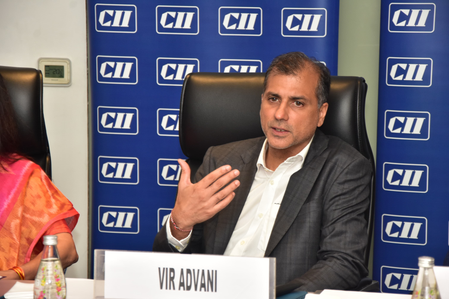
Ahmedabad, Aug 14 (IANS) Gujarat’s next phase of industrial growth will depend on improving export competitiveness, scaling up MSMEs, developing future-ready skills and attracting investment in advanced manufacturing, according to CII Western Region chairman Vir S Advani, who said the industry body is working closely with governments at both the central and state levels on reforms.
Speaking at a Confederation of Indian Industry (CII) media roundtable in Ahmedabad, Advani said the Indian industry had faced a difficult period because of high inflation and rising import costs, while uncertainty over US tariffs was adding to pressure on exporters.
He said CII is nevertheless more optimistic about the India-US situation than it had been earlier in the year.
“This 100 per cent tariff is the big elephant. That’s what’s concerning everyone,” Advani said, adding that there is now “very heavy bilateral conversation and communication” between India and the US.
He said CII expected the issue to be negotiated and hoped India would eventually secure a position favourable compared with its competitors.
Advani said the tariff uncertainty had also highlighted the need for Indian companies to reduce their dependence on the US market by diversifying both their export destinations and product baskets.
“We only export such few products and only to such few countries. So diversification is the most important thing,” he said, pointing to the UK, European Union and Australia as markets that Indian companies should examine more closely.
He said CII is working with the Ministry of Commerce on a product and country-level approach following the signing of free trade agreements, identifying opportunities down to the six-digit HSN code level.
He said the immediate focus should be on reducing the cost of doing business and improving ease of doing business so that Indian companies, particularly MSMEs, could become more competitive exporters.
“While the government is talking about reducing import, we in CII believe that there’s an opportunity to increase export. If we’re able to increase export, you can still get a balance of payment, which is what is essential to manage our currency,” he noted.
He said reforms to GST, customs and indirect taxes could also free up capital tied up in businesses. Decriminalisation of provisions in laws, he added, could increase confidence among entrepreneurs and encourage investment.
Advani said MSME competitiveness was a major priority for CII because smaller businesses often lacked the resources to identify overseas markets, improve competitiveness and manage multiple functions at once.
CII’s Western Region is preparing an “SME to MNC” programme covering Gujarat, Maharashtra and Goa, under which larger companies would work with smaller businesses in their supply chains.
The proposed programme would focus on SMEs with revenues of around Rs 100 crore and provide structured support over 24 months through CII’s Centre of Excellence on MSME Competitiveness.
The objective would be to help selected businesses scale substantially and eventually enter international markets.
“If we can create even 20 companies who can come out of this Rs 100 crore range, which is where they barely stop because of all their priorities and things, if 20 of them can become Rs 1,000 crore companies with CII’s help, then from Rs 1,000 crore to Rs 10,000 crore, they’ll do on their own,” Advani said.
Artificial Intelligence is another area where CII is seeking to help smaller businesses.
Advani said the organisation had conducted workshops on using AI in business and is examining ways to improve access to technology for MSMEs, which may struggle with the cost of advanced AI tools.
He noted that CII is also facilitating links between start-ups developing technology and established companies through its Centres of Excellence.
The organisation is particularly interested in the potential of open AI models and regional-language models, which could reduce dependence on expensive closed systems.
“CII is not currently undertaking sector-specific studies on AI, with its work instead focused on broad-based learning, training and adoption,” he said.
Advani also highlighted the role of CII in translating central reforms into state-level implementation. He said the organisation had worked with Gujarat and other state governments on GST, labour codes and other concurrent matters.
“Gujarat being one of the best examples,” he said, adding that CII’s central team worked with the Union government while its state teams engaged with individual state administrations.
The discussion also focused on Gujarat’s emerging position in the data centre sector.
Achal Bakeri, chairman of CII Gujarat, said the state could become a major data centre hub because of its availability of land, power and relatively low construction costs, as well as submarine data cables landing along its coastline. He identified Dholera as a key location.
“The ambition is for Gujarat to be the data centre capital of this country, if not of Asia,” Bakeri said. He acknowledged that water availability remained an important question for large data centre projects and that environmental considerations would have to be addressed.
Gujarat’s recently introduced Data Centre Policy 2026-29 targets 7.5 GW of capacity and seeks to attract large-scale investment in hyperscale and digital infrastructure.
Bakeri also welcomed the Viksit Gujarat Industrial Policy 2026, Gujarat Shipbuilding and Repair Policy 2026 and Data Centre Policy 2026-29, saying they strengthened the state’s manufacturing, maritime and digital ambitions.
He described CII Gujarat’s guiding theme as “Virasat Se Vikas: Gujarat@2047”, with development rooted in the state’s heritage, enterprise and craftsmanship.
Advani said the Vibrant Gujarat Regional Conferences had helped extend investment outreach beyond Ahmedabad and Gandhinagar by bringing the process closer to investors across different parts of the state.
He expects the Vibrant Gujarat Global Summit in January 2027 to bring greater attention to advanced manufacturing, semiconductors, defence and aerospace, AI and data centres.
“I think the nature of the investment will go more towards advanced manufacturing, because that’s also the direction India is in,” he said.
CII is also recommending a broader tourism-led development approach that links tourism with sports, heritage and conservation.
Advani said Gujarat’s expanding air connectivity, including smaller-city links, could help spread tourism beyond established destinations and generate employment and skills while contributing to wider development.
He said CII would support the Gujarat government in its preparations for the 2027 summit and continue working on policy advocacy, manufacturing, exports, renewable energy, logistics, skills and MSME development.
“Gujarat is India’s industrial powerhouse and a strong platform for the next generation of growth,” Advani said, adding that CII’s role was to bring industry’s collective experience to government, co-create solutions and translate priorities into measurable outcomes.
–IANS
mys/rad