



United Nations, July 23 (IANS) India has made clear to Pakistan that the Indus Water Treaty will remain suspended as long as Islamabad is committed to cross-border terrorism as state policy.
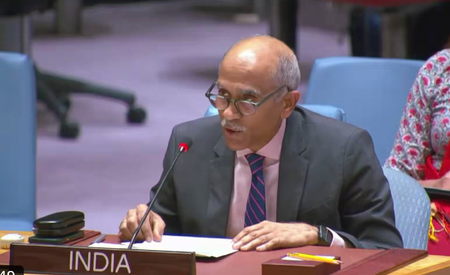
“Our position on the Indus Water Treaty remains clear and consistent,” India’s Permanent Representative P. Harish told Pakistan at the Security Council on Wednesday.
“Cooperation on the basis of mutual trust and goodwill cannot be expected when cross-border terrorism is regularly deployed as an instrument of State policy,” he said.
Harish gave the stern reminder to Islamabad when its Permanent Representative Asim Iftikhar Ahmad brought up the Indus Water Treaty and Kashmir at the high-level open debate on ‘Natural Resource Governance: The Foundation of Peace, Security and Prosperity’.
He said that Pakistan’s “eastern neighbour” was “unilaterally and illegally placing the Indus Waters Treaty in ‘abeyance’” and this was “happening in the backdrop of ‘the Jammu and Kashmir dispute’”.
India suspended the 1960 Indus Water Treaty for sharing the waters of the river after Pakistan-based terrorists killed 24 people in the tourist resort of Pahalgam in a religiously motivated attack in April last year.
“Water and blood also cannot flow together”, Prime Minister Narendra Modi said, explaining the rationale for putting the treaty in abeyance as well as suspending trade with Pakistan after the Pahalgam attack.
The Union Territory of Jammu and Kashmir “has always been, is, and will remain an integral and inalienable part of India”, Harish said.
“This is the constitutional and legal reality that Pakistan deliberately chooses to ignore”, he said.
“The only outstanding issue with regard to Jammu and Kashmir is the naked aggression and illegal occupation of India’s sovereign territory by Pakistan”, he said.
The Security Council in its resolution adopted on April 21, 1948, demanded that Pakistan withdraw its troops and nationals from Jammu and Kashmir, prevent intrusions into it, and not aid those fighting in the state.
Pakistan has been brutally putting down protests by Kashmiris in the territory it occupies, and over 30 people have been killed since June by its security forces.
In the most recent incident, six Kashmiris were killed by its security forces in Tararkhal on July 14.
“Instead of pointing fingers at India, Pakistan would serve itself and its people far better by putting its own house in order,” Harish said.
–IANS
al/sd/