



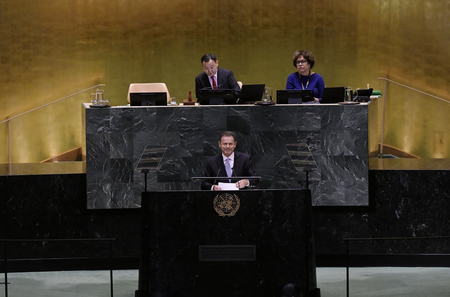
United Nations, Sep 26 (IANS) India’s campaign for a permanent seat on the UN Security Council has received fresh backing at the General Assembly, with Portugal and Mauritius explicitly supporting New Delhi and the Marshall Islands endorsing Japan and its G4 partners.
The endorsements came during the 81st General Assembly debate here at the UN headquarters in New York, amid wider calls to make the Council reflect present-day regional and political realities.
Portuguese Prime Minister Luis Montenegro called for a more representative Council with permanent seats for Africa, Brazil and India.
Mauritian Foreign Minister Dhananjay Ramful gave the clearest direct endorsement in his Friday address.
“We support the positions of the G4 and of L69 on Council reform, and we reiterate our support for India’s candidature for a permanent seat, commensurate with its constructive role in global affairs,” Ramful said.
Mauritius also backed the Common African Position. It calls for no fewer than two permanent and five non-permanent African seats. Ramful said any new permanent member should receive the same rights as the original permanent members if the veto is retained. He also supported a seat for small island developing states.
Marshall Islands President Hilda Heine added indirect support for India through the four-nation G4 grouping.
“The Marshall Islands affirms its longstanding support for Japan – and its G4 partners – to achieve permanent membership on the UN Security Council,” Heine said in her address.
Japan also made reform a central demand, although Prime Minister Sanae Takaichi did not name India or the other G4 candidates in that passage.
“We need to transform it without delay into a structure that truly reflects the current realities of the international community,” Takaichi said of the Council.
She said both permanent and non-permanent categories should be expanded, adding that a majority of UN members supported enlargement in both.
Other leaders sought broader regional representation without endorsing particular countries. Finnish President Alexander Stubb proposed at least two new permanent seats for Africa, two for the Asia-Pacific and one for Latin America. He also opposed giving any single state veto power.
Saint Lucian Prime Minister Philip J. Pierre pressed for a rapid end to years of inconclusive negotiations.
“The prolonged reform process must be concluded quickly to include expanded permanent and non-permanent membership for Africa, the Asia-Pacific, and Latin America and the Caribbean regions,” Pierre said.
African leaders mounted the strongest collective case for change. Sierra Leone President Julius Maada Bio said the institution remained anchored in an earlier era.
“The Security Council still reflects the world of 1945. Africa, home to more than 1.6 billion people and the subject of much of the Council’s work, still has no Permanent Seat,” Bio said.
Ghanaian President John Dramani Mahama framed the question as one of institutional survival.
“Security Council reform is not a favour to Africa; it is an imperative for the legitimacy, credibility, and survival of the United Nations,” Mahama said.
The speeches showed broad agreement that the Council is outdated. But differences remain over national candidates, regional allocation and the veto, preventing negotiations from producing a reform package.
India, Brazil, Germany and Japan make up the G4 and support one another’s campaigns for permanent membership. India has cited its population, economic weight, UN peacekeeping record and role as a voice of the Global South in arguing that the Council no longer reflects contemporary realities.
The Council has five permanent members with veto power — China, France, Russia, Britain and the United States — and 10 elected members serving two-year terms. Changing its composition requires approval by two-thirds of the General Assembly and ratification by two-thirds of UN members, including all five permanent members.
–IANS
lkj/as