



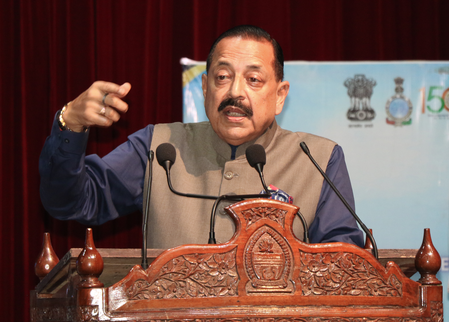
New Delhi, July 18 (IANS) India’s first privately developed orbital launch vehicle, Vikram‑1, successfully reaching its designated low Earth orbit proves the country’s emergence as a serious global player, Union MoS, Science & Technology, Earth Sciences Dr. Jitendra Singh said on Saturday.
As per the statement from the Department of Space, it stands as a powerful vindication of Prime Minister Narendra Modi’s decision to open the country’s space sector to private participation, the minister added.
Mission Aagaman demonstrated the strength of India’s public‑private partnership model enabled by the collaborative efforts of the Department of Space, ISRO, IN-SPACe and India’s vibrant start-up ecosystem.
“Had Prime Minister Narendra Modi not taken the bold decision to open India’s space sector to private enterprise, the country would not have witnessed this historic achievement,” Dr. Jitendra Singh said.
He said the reforms have unlocked the immense potential of Indian innovators, providing them access to national space infrastructure and creating an ecosystem where world-class technologies can now be conceived, developed and launched entirely from India.
Singh said Vikram-1 has demonstrated an exceptional level of technological maturity for a maiden orbital mission. Unlike many maiden launches that carry only dummy masses, Vikram‑1 carried experimental payloads and customer demonstrations from Indian and international partners, he said.
The mission also flew customer payloads and technology demonstrations from Indian and international partners, reflecting the growing confidence of the global space community in India’s commercial launch capabilities.
Vikram‑1, built entirely in India, can place up to 350 kilograms into low Earth orbit and incorporates indigenous breakthroughs including an all‑carbon composite orbital rocket, a fully 3D‑printed liquid engine for its Orbital Adjustment Module, advanced ultra-low-shock pneumatic separation systems and a long monolithic carbon‑composite rocket stage.
The statement highlighted India’s space reforms since 2020 that helped grow 400 spave startups, first space unicorn, and a space economy approaching $9 billion, with a national vision of expanding it to nearly $44 billion over the next decade.
—IANS
aar/ag