



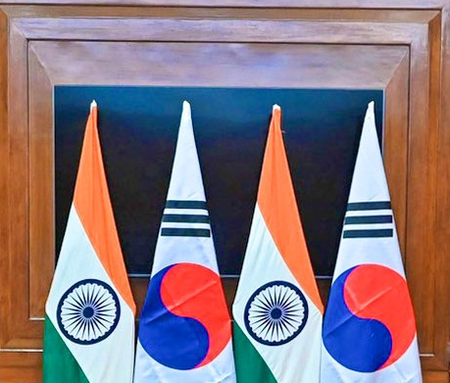
New Delhi, Nov 12 (IANS) India and South Korea can accelerate shipping decarbonisation through a green-ammonia corridor, regardless of delays in global carbon-pricing negotiations, a new report has said ahead of the International Maritime Organization session on December 4, deciding on a binding carbon price.
The report from India Narrative suggested a bilateral corridor between India and South Korea rather than a dozen pilots.
“Pick an Indian anchor, Tuticorin or Kandla, and a Korean one, Ulsan, which Seoul has designated as its ammonia and methanol bunkering hub,” the report said, suggesting both countries to also commit a handful of Korean-built, ammonia-capable ships to run between them, with fuel from Indian electrolysers.
South Korea has advanced shipbuilding and ammonia-ready vessels but lacks domestic green fuel production, while India has ambitious green-hydrogen and ammonia plans but needs reliable buyers.
As many such negotiations from the International Maritime Organisation or similar bodies failed to reach any agreement, the publication pointed out that “shipowners cannot wait for diplomats and a vessel ordered today will burn fuel into the 2050s.”
“Two countries that can solve the problem bilaterally are sitting on opposite sides of the Bay of Bengal and the East China Sea, and they have barely begun to talk to each other seriously,” the report noted.
The publication also suggested both countries to blend finance, adding that dual-fuel and ammonia-ready ships carry a premium that independent owners find it difficult to bridge with ordinary bank debt.
“India has a roughly $3 billion Maritime Development Fund, and both countries have export credit agencies and development banks,” the report said.
South Korea imported $518 million of ammonia in 2025, mostly from Indonesia, Saudi Arabia, China, Australia and Malaysia. Renewables supplied 11.4 per cent of its electricity by the end of 2025, against a 20 per cent target for 2030.
—IANS
aar/ag