



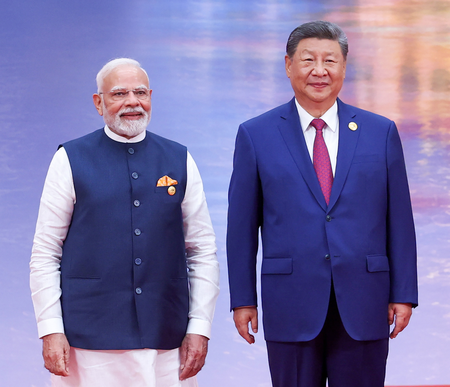
New Delhi/ Beijing, Sep 1 (IANS) Although India and China may not agree on Asia’s future or emerge as strategic partners, the two countries need a pragmatic and functional relationship that allows them to pursue their respective interests while preventing differences from escalating into confrontation, a report has stated.
It argued that a more balanced economic relationship would benefit both countries, reducing India’s vulnerability to disruptions while giving China greater access to one of the world’s fastest-growing major markets.
“India and China are often described as the two great civilisational powers of Asia, two of the world’s largest countries and increasingly important poles in a changing international order. All of this is true. Yet there is an important asymmetry in their relationship that is less often acknowledged: India and China do not attach the same strategic importance to each other,” former Indian diplomat Sanjay Kumar Verma wrote in ‘India Narrative’, recently.
“For India, China is arguably one of the most consequential external relationships. It affects India’s security, its borders, its neighbourhood, its economic choices and its strategic partnerships. For China, India is undoubtedly important, but it is one among several major relationships competing for Beijing’s attention—above all the United States, Taiwan and the Western Pacific, Russia, Japan, Europe and Southeast Asia,” he added.
Verma noted that the sharp deterioration in ties between India and China following the 2020 Galwan crisis has gradually given way to cautious normalisation since 2024.
“Direct flights have resumed, visa procedures have been eased, the Kailash Mansarovar pilgrimage has resumed and several institutional and people-to-people exchanges are being restored. At the same time, the latest border consultations in August 2026 again underlined the importance of maintaining peace and tranquillity along the frontier. The continuing sensitivity of the border is a reminder that normalisation remains a work in progress,” he highlighted.
According to Verma, the challenge is not merely to ease tensions but to determine whether India and China can build a relationship in which intense competition does not spiral into confrontation. He added that neither country can afford a permanently fractured and adversarial relationship.
“There is an important adjustment that Beijing needs to make. India is no longer a peripheral Asian power whose strategic choices can be influenced primarily through pressure. Its economic weight, military capabilities, geographic position, international partnerships and growing influence in the Global South make India’s rise a structural feature of the Asian order,” he detailed.
Emphasising the importance of people-to-people contact, Verma said that the strained bilateral ties have sharply narrowed avenues for students, scholars, journalists, business communities and tourists to engage with one another.
“When societies stop talking to each other, governments increasingly encounter one another through narrow strategic narratives. Restoring academic, cultural, business and tourism exchanges is therefore not merely a matter of goodwill. It can help close the growing gap in how the two societies perceive each other,” he stressed.
–IANS
scor/ksk/as