



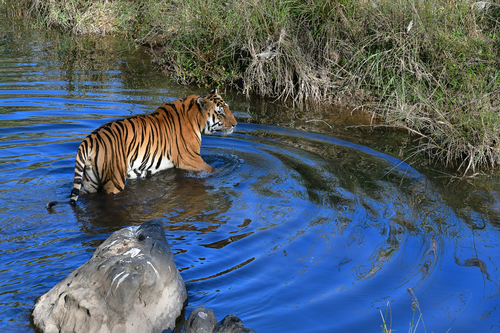
Hyderabad, May 8 (IANS) Tourism and human activity are pushing India’s tigers towards stress and affecting their breeding, reveals a new study at the CSIR-Centre for Cellular and Molecular Biology (CCMB).
The study, published in the Zoological Society of London journal Animal Conservation, is the first to combine non-invasive stress and reproductive hormone analyses from tigers across five major Indian tiger reserves: Corbett (Uttarakhand), Tadoba–Andhari (Maharashtra), Kanha and Bandhavgarh (Madhya Pradesh), and Periyar (Kerala).
The study highlights issues for each of these tiger reserves to inform better tiger management, the CSIR-CCMB said in a release on Friday.
Many previous studies by Dr G. Umapathy at the CSIR-CCMB had established that tourism and other anthropogenic activities in tiger reserves cause stress in tigers. This time, he led the team to systematically assess how human activities affect tiger breeding.
For the first time, scientists have tracked tigers across different parts of India through four seasons over two years to understand how human presence impacts tiger well-being.
The team analysed 610 genetically confirmed tiger scat samples, including 291 females and 185 males, collected between 2020 and 2023. They measured two key hormone markers in these samples — faecal glucocorticoid metabolites (a biomarker of stress) and faecal progesterone metabolites (an indicator of breeding activity in females). Across all reserves, tigers ranging close to tourism roads and in areas with greater human disturbance consistently showed elevated stress hormone levels.
A particularly striking finding is that tigers in the strictly protected core zones showed higher stress response to human-caused disturbance than those in the multi-use buffer zones.
Buffer-zone tigers appear to have habituated to year-round human presence, whereas core-zone tigers register sharp spikes in stress when seasonal tourism enters these areas. This challenges the assumption that core zones are uniformly low-stress refuges. The effect was most pronounced in Tadoba and Bandhavgarh.
“Tigresses prefer to breed in the quiet parts of the forests. However, it is becoming difficult to find such suitable areas. In Tadoba and Corbett, the buffer zones already have high tiger populations. It is concerning if the core areas of the forests also become stressful for the tigresses,” said Dr Umapathy, Chief Scientist at CSIR-CCMB. “Not only is the reproductive success of tigers lower under stress, but the young ones will also grow up differently in such conditions.”
“This study is a fine example of how molecular biology and physiology can be applied directly to one of India’s most important conservation priorities,” CSIR-CCMB Director, Dr Vinay Nandicoori, said.
“CSIR-CCMB takes pride in housing the Laboratory for the Conservation of Endangered Species (LaCONES), which has grown into a national resource for non-invasive wildlife monitoring. We hope these findings will be useful to the National Tiger Conservation Authority and state forest departments as they continue to fine-tune the management of India’s tiger reserves,” he said.
“We are not arguing against wildlife tourism, which plays a vital role in conservation funding and supports rural livelihoods,” said Dr Umapathy. “But our findings make a clear scientific case that the regulation of tourism, including vehicle numbers, safari timings, road density, and the protection of breeding areas, needs to be informed by what the animals are actually telling us through their physiology.”
The study suggests key management recommendations, including strict regulation of tourist vehicle numbers and prevention of vehicle crowding at tiger sightings; reduction of safari duration by approximately one hour in both morning and evening sessions; strengthened management of buffer zones, particularly in Tadoba and Bandhavgarh, to mitigate high anthropogenic disturbances; creation of additional water bodies along non-tourism routes to reduce dependence on roadside waterholes; and continuous, non-invasive physiological monitoring of known tigresses to identify and protect breeding hotspots.
The other authors who participated in this study are Aamer Shoel, Vinod Kumar, Gudimella Anusha, and Andre Ganswidt.
–IANS
ms/vd