



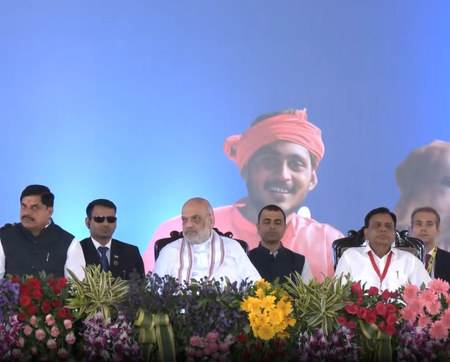
Bhopal, Oct 3 (IANS) Union Home Minister Amit Shah on Saturday set December 31, 2029, as the deadline to make Madhya Pradesh drug-free. He said he would work with Chief Minister Mohan Yadav and senior Home Department officials to prepare a detailed plan to achieve this target.
Addressing a state-level conference of cattle rearers in Bhopal, Shah appealed to the people of Madhya Pradesh to actively cooperate in the campaign against narcotics and made a special appeal to mothers to remain vigilant about the impact of drugs on their children.
“We will make Madhya Pradesh drug-free. I have come here to assure every mother that after December 31, 2029, there will be no place for drugs in Madhya Pradesh for your sons and daughters. I have come here to put in place a detailed plan to achieve this,” Shah said.
The Home Minister said he would hold a meeting with the Chief Minister and officials of the Home Department to discuss the measures required for the campaign.
The announcement comes amid the Centre’s intensified campaign against narcotics, with the Union Home Ministry focusing on dismantling drug networks while strengthening prevention, treatment and rehabilitation measures.
Shah also inaugurated an exhibition on the new criminal laws in Bhopal and said the Bharatiya Nyaya Sanhita and related legislation would bring a fundamental change in the country’s criminal justice system.
He said the new framework was designed to ensure that criminal cases are disposed of within a defined timeframe, ending the culture of prolonged litigation and repeated adjournments.
“Today, I inaugurated an exhibition on the new criminal laws. I want to assure the people of Madhya Pradesh — whose justice system was once notorious for endless adjournments (‘tarikh pe tarikh’) — that within a year or a year-and-a-half, the process will ensure that a guilty person is convicted within three years of the FIR being lodged, right up to the Supreme Court level,” Shah said.
The Union Minister said the new laws marked a shift from the approach followed under the British-era criminal justice framework, which, he alleged, was primarily designed to protect the colonial government and administration.
“The laws enacted by the British were designed to protect their own government and administration. The new laws, however, are aimed at safeguarding the dignity, property, and physical safety of Indian citizens. Their core principle is justice, not merely punishment,” Shah said.
The Bharatiya Nyaya Sanhita, Bharatiya Nagarik Suraksha Sanhita and Bharatiya Sakshya Adhiniyam replaced the Indian Penal Code, Code of Criminal Procedure and Indian Evidence Act respectively from July 1, 2024.
–IANS
pd/snj/skp