



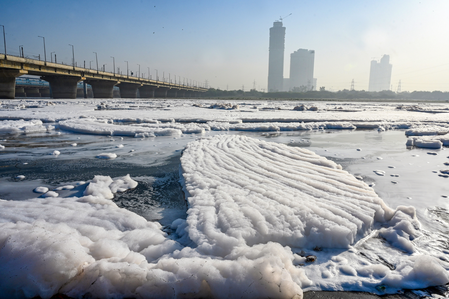
Chandigarh, May 19 (IANS) In a major step towards rejuvenating the Yamuna river and reducing pollution entering Delhi through inter-state drains, the Haryana government has launched an extensive action plan focusing on sewage treatment, industrial waste management, and real-time monitoring of drain pollution.
Chief Secretary Anurag Rastogi on Tuesday reviewed the progress of the state’s comprehensive pollution control strategy aimed at preventing contaminated water from state drains from entering Delhi through the Yamuna river system.
The review meeting focused on strengthening sewage treatment infrastructure, reducing biochemical oxygen demand, and ensuring strict monitoring of industrial discharges across the state.
At the meeting, officials reviewed the implementation of the Ministry of Home Affairs’ directions on sewerage and industrial waste management in Haryana.
The discussions also covered pollution control measures for inter-state drains entering Delhi from Haryana, including Drain No. 6, Mungeshpur Drain, Bupania Drain, and Palam Vihar Drain.
Haryana State Pollution Control Board Chairman Vinay Pratap Singh said the state would undertake zone-wise drone surveys to map all drains and sub-drains discharging into the Yamuna and monitor both water flow and water quality.
He said the initiative aimed to identify pollution hotspots and strengthen source-level monitoring, on the lines of similar surveys being conducted in Delhi.
The review highlighted that Haryana has already operationalised 90 sewage treatment plants with a combined treatment capacity of 1,518 million litres per day across 34 towns.
Additionally, four sewage treatment plants with a capacity of 170 million litres per day are under construction, while nine plants with a capacity of 227 million litres per day are being upgraded to improve treatment efficiency.
On the industrial side, 17 common effluent treatment plants with a combined capacity of 184.5 million litres per day are operational in the state.
Two common effluent treatment plants with a capacity of 19 million litres per day are under upgradation, while eight new common effluent treatment plants with a capacity of 146 million litres per day have been proposed to strengthen industrial wastewater treatment infrastructure.
Officials said nine new sewage treatment plants with a proposed treatment capacity of 510 million litres per day are planned under the future expansion strategy.
The Haryana State Pollution Control Board has also prepared a detailed action plan covering sewage treatment plants, common effluent treatment plants, and drain-tapping projects to ensure compliance with pollution control norms.
Work on different components of the project is already underway, with timelines ranging from December 2025 to December 2028.
–IANS
vg/dan