



Ahmedabad, June 11 (IANS) On the afternoon of June 12, 2025, as emergency crews rushed towards the wreckage of Air India flight AI-171 in Ahmedabad, one of the first specialist police units to be mobilised was the city’s K9 squad.
The London-bound Boeing 787-8 Dreamliner had crashed shortly after take-off from Sardar Vallabhbhai Patel International Airport (SVPIA), striking the campus of B.J. Medical College and its surrounding residential buildings in the Meghaninagar area.
Of the 12 crew members and 230 passengers on board, only one passenger survived. On the ground, 19 people were killed, and 67 others were seriously injured. In total, 260 people died.
The impact triggered a major fire, destroyed parts of the medical college complex and hostel facilities, and launched one of the largest rescue and recovery operations in Gujarat’s recent history.
Emergency responders reached the scene within minutes, while firefighters battled intense flames and worked to rescue survivors trapped in the damaged structures.
Around 30 people were rescued during the initial response, even as the fire and heat made access to parts of the site extremely difficult.
Amid the arrival of firefighters, police personnel, National Disaster Response Force teams, State Disaster Response Force teams, medical staff and other central agencies, Ahmedabad Police’s K9 Unit was dispatched to the scene after reports of the explosion and crash emerged.
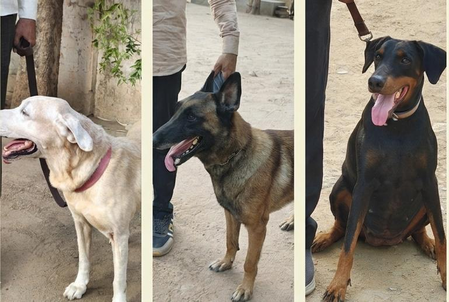
Head Constable Balvant Singh was among the first K9 handlers to arrive, accompanied by Ela, a Doberman trained in explosive detection.
Initially deployed after reports of a blast, the team remained on standby for hours as firefighters worked to bring the blaze under control and authorities assessed the risks posed by fuel, debris, and damaged structures.
The conditions were unlike those faced in most search operations.
The crash had produced a fierce fire, while sections of the college campus and hostel buildings remained unstable. Thick black smoke continued to rise from the wreckage long after the impact.
Officials later said the extreme heat generated by the crash had complicated rescue and identification efforts.
For the first 24 hours, the K9 Unit remained ready for deployment while emergency crews focused on firefighting, rescue work and securing the site.
Even after the flames had largely been contained, heat continued to radiate from the wreckage, and smoke lingered across the area. Once search operations expanded, tracker dogs were brought into the recovery effort.
Head Constable Ramdevsinh Jadeja entered the operation with Electric, a Belgian Malinois tracker dog trained to locate human remains and assist in search missions.
As recovery teams began the painstaking task of clearing debris and inspecting damaged buildings, Electric was deployed to identify areas requiring closer inspection.
Later, Head Constable Mayursinh Parmar joined the operation with Tyson, a Labrador tracker dog. Tyson assisted police in locating human remains within the disaster zone, including the remains of a victim’s leg.
Such recoveries became particularly important because many victims could only be identified through forensic examination and DNA testing.
Authorities eventually relied extensively on DNA analysis to identify those killed in the crash and on the ground.
While the tracker dogs searched for victims, Balvant Singh and Ela continued conducting sweeps for explosives or other hazardous materials that could pose a danger to rescue workers operating within the wreckage.
The work continued well beyond the first day. For five consecutive days, the Ahmedabad K9 Unit operated at the crash site in six-hour rotational shifts.
During that period, the dogs and their handlers worked amid fire-damaged structures, unstable debris, lingering smoke and intense summer temperatures.
According to police personnel involved in the operation, the unit helped locate the remains of seven to eight victims.
“Those discoveries were considered significant because even small remains could provide crucial evidence for identification through DNA testing,” officials told IANS.
The search frequently required handlers and dogs to enter damaged and potentially hazardous buildings.
By then, recovery teams were still finding human remains as wreckage was lifted and cleared from the site.
Search operations continued for days after the crash, with recovery personnel combing through debris from hostel buildings, residential blocks and the aircraft itself.
For the dogs, the environment presented its own challenges. Working dogs generally struggle in prolonged extreme heat, and the combination of high temperatures, smoke and debris made the operation especially demanding.
Yet the animals continued searching throughout the five-day deployment. The Ahmedabad Police K9 Unit currently has 16 fully trained dogs, including experienced senior dogs.
The unit’s capabilities are divided into three broad specialisations: narcotics detection, explosive detection, and tracking and search work.
Depending on the requirement, dogs are trained to detect drugs, identify explosives and hazardous substances, recover stolen property, locate missing persons, and assist in searches for both living and deceased individuals.
“As the first anniversary of the crash approaches, these ‘voiceless’ sleuths helped agencies in many ways,” officials added.
–IANS
mys/dan