



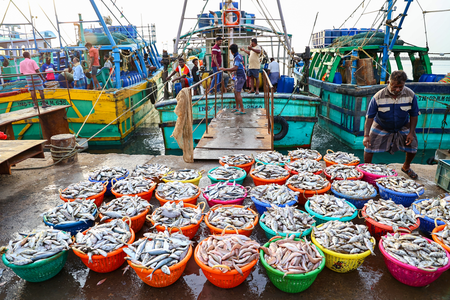
New Delhi, July 22 (IANS) The government on Wednesday said that projects for the development of the fisheries and aquaculture sector, amounting to Rs 21,394.88 crore with a Central share of Rs 9,510.89 crore, have been approved under the Pradhan Mantri Matsya Sampada Yojana (PMMSY), including those for the creation and strengthening of export infrastructure.
According to Department of Fisheries, the government is implementing several strategic initiatives to strengthen seafood export infrastructure through the Fisheries and Aquaculture Infrastructure Development Fund (FIDF), under which 18 major projects, with a total project cost of Rs 345.89 crore, have been supported, primarily for the expansion and modernization of fish processing plants.
“In addition, the MPEDA is implementing the Technology Development for Specific Value-Added Marine Products (TDSVMP) Scheme, under which financial assistance is provided for the development of value-added infrastructure,” Fisheries, Animal Husbandry and Dairying Minister, Rajiv Ranjan Singh, said in the Rajya Sabha in response to a question.
The scheme supports the establishment and modernization of fish processing facilities, cold storage, automated processing machinery, infrastructure for handling live, chilled, ornamental, and dried fish, and the development of new value-added seafood products.
During the period from 2021-22 to 2025-26, MPEDA has provided financial assistance of Rs 118.10 crore to 89 seafood processing units for infrastructure development under the Scheme, the minister informed.
The Export Inspection Council (EIC), under the Department of Commerce, is the Competent Authority for quality control and inspection of notified export products, including marine products.
According to the minister, to ensure compliance with importing countries’ requirements, EIC conducts periodic training on Food Safety Management System (FSMS) requirements for approved seafood export establishments and mandates testing of aquaculture shrimp for banned antibiotics during export certification.
The MPEDA supports these efforts through pre-harvest testing, certification programmes such as SHAPHARI, and, together with the Coastal Aquaculture Authority (CAA) and EIC, implementing the National Residue Control Plan (NRCP) to strengthen residue monitoring, traceability, and compliance with international standards.
The Department of Fisheries has also released the National Framework on Traceability in Fisheries and Aquaculture, 2025, to establish a national digital traceability system across the fisheries and aquaculture value chain.
The Framework aims to ensure compliance with domestic and international requirements, strengthen food safety, quality assurance, and transparency, enhance consumer confidence, and facilitate market access, thereby boosting seafood exports.
–IANS
na/