



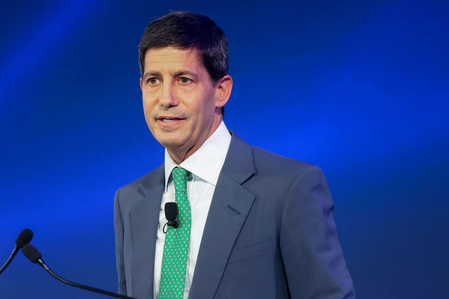
Asheville, Aug 31 (IANS) The global economy has moved beyond an era of weak investment and prolonged stagnation into a period of stronger growth and an international investment surge, Federal Reserve Chairman Kevin Warsh told G20 finance ministers and central bank governors.
Addressing the opening session of the G20 financial meeting in Asheville, North Carolina, Warsh said the world economy had reached what an old mentor of his called “a hinge point in history”.
The moment required policymakers to draw on the traditions and knowledge of their institutions while recognising the need for change, he said.
Warsh, who was attending the G20 finance track for the first time in his new position, said the economic assumptions that dominated international policy discussions during and after the global financial crisis no longer appeared relevant.
He pointed to two ideas that were once treated as conventional wisdom among academics and policymakers: secular stagnation and a global savings glut.
Secular stagnation described an economy suffering from persistently weak growth, limited investment and a belief that the most important innovations had already taken place.
“Secular stagnation seems like a description of a past long ago,” Warsh said, recalling comments he had made at Jackson Hole days earlier.
“The new period is one of secular growth,” he said.
Warsh said the G20 discussions would examine whether the improved growth prospects in member countries were cyclical or structural. He also planned to share his assessment of developments in the United States.
A cyclical expansion is generally linked to shorter-term changes in economic activity, while structural growth reflects more lasting changes in investment, productivity and the capacity of an economy.
Warsh also challenged the earlier expectation of a global savings glut. Under that theory, large pools of capital would remain on the sidelines because there were too few productive opportunities for investment.
“From our discussions even in the last day, that sure seems like a very long time ago,” he said.
“If I were to try to characterise this moment, it would be one of a global investment surge.”
Warsh said those shifts would form part of the discussions among G20 participants over the following two days. Finance ministers and central bankers entered the meeting with different responsibilities and institutional mandates, but also faced shared challenges, he said.
“The G20 is a rare opportunity for us also to share thoughts,” Warsh said. “We’ve got a lot of common objectives, a lot of common challenges.”
Treasury Secretary Scott Bessent, who opened the meeting, placed economic growth at the centre of the United States’ G20 agenda. He said the conditions needed for growth included abundant resources, clear rules and strong markets.
Bessent said the United States was bringing business leaders and policymakers together to identify barriers to expansion and develop reforms. The initiative would also help shape efforts to modernise financial regulation and supervision.
“Smart rules preserve competence without smothering initiative,” Bessent said.
The G20 was established in 1999 as a forum for finance ministers and central bank governors following financial crises that demonstrated the need for broader global economic coordination. Its role expanded after the 2008 financial crisis, when meetings of national leaders became a central part of the forum’s work.
The group comprises 19 countries, the European Union and the African Union. Its finance track focuses on international economic coordination, financial stability, sovereign debt and development financing.
–IANS
lkj/dan