



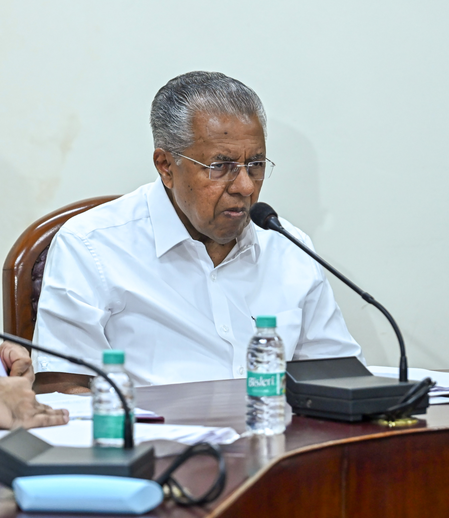
Thiruvananthapuram, Nov 21 (IANS) Former Kerala Chief Minister Pinarayi Vijayan’s attack on Congress leader Rahul Gandhi over his comments on India’s ties with Israel has reignited debate over how political parties navigate international issues amid domestic political considerations.
Speaking at the University of Chicago, Rahul Gandhi defended India’s strategic relationship with Israel and supported the continued defence purchases from the country.
Vijayan, in a social media post, said: “Rahul Gandhi’s remarks at the University of Chicago expose the Congress party’s glaring hypocrisy on Palestine. At a time when Gaza is witnessing one of the most devastating genocides of our time, with thousands of innocent children among its victims, he openly advocates stronger ties with Israel and arms purchases from a state responsible for their slaughter. “
“His attempt to strike a diplomatic balancing act in the face of this catastrophe is indefensible. His pro-imperialist position also undermines the legacy of Nehru, whose foreign policy stood firmly against imperialism and in solidarity with the Palestinian struggle. There can be no balancing act when humanity is on trial,” Vijayan added.
However, Vijayan’s own political past offers an interesting perspective on the debate. On December 30, 2006, Kerala witnessed a three-hour statewide shutdown following the execution of former Iraqi President Saddam Hussein.
The shutdown, which began at 3 p.m., was marked by widespread protests against the United States, including demonstrations and effigy burnings targeting then President George W. Bush. Both — the CPI(M) and the Congress — supported the shutdown.
Then Chief Minister V.S. Achuthanandan condemned the execution, while Vijayan, who was the CPI(M) state secretary, described Saddam as a nationalist resisting Western oil imperialism.
The Congress, which Vijayan now accuses of hypocrisy, was also part of the political mobilisation over Saddam’s execution.
Kerala has a sizeable Muslim population, accounting for around a quarter of its population, and Palestine has remained an important political and emotional issue for both the CPI(M) and the Congress.
The latest exchange once again raises questions about how political parties reconcile their international positions with domestic political considerations.
–IANS
sg/skp