



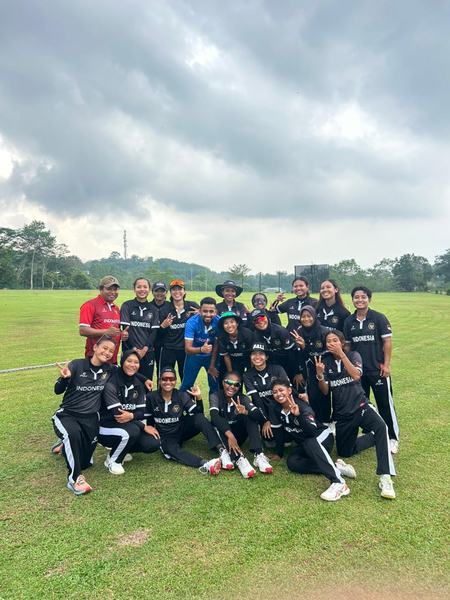
New Delhi, Aug 31 (IANS) Twelve years ago, Indonesia had no Women’s T20I status, no turf ground, and, the federation admits, barely a cricket structure outside expatriate clubs. On Monday, at Dubai International Stadium, the Indonesia senior women’s team will walk out for their first-ever Women’s Asia Cup match against Bangladesh. They will also take on defending champions Sri Lanka and hosts UAE.
For Indonesia, the fourth most populous country in the world with over 17,000 islands, it’s a milestone twelve years in the making, one that almost nobody outside the country saw coming. Leading them out will be Ni Putu Ayu Nanda Sakarini, a wicketkeeper-batter who discovered the sport at high school in 2013.
Badminton, not cricket, was the sport she grew up with. Her parents dabbled in it too, and badminton remains Indonesia’s standout Olympic sport, with eight golds, six silvers and eight bronzes. “Because of that, I loved the sport. But badminton has so many players, and it was difficult to be involved in the national team. So, I thought cricket was good for me, and now it’s my career,” Nanda told IANS.
After an early development tour to Jaipur in 2015, after a national women’s championship was set up in 2014 to provide a more formal competitive competition, Nanda made her Indonesia T20I debut in 2019. Now she captains a side making its maiden appearance in Asian cricket’s flagship senior event. “It’s really an exciting and incredible feeling and a big honour for me to lead Indonesia on such a big stage.
“I feel very proud to be part of this journey. It’s taken a long time for me to get into this position. Moreover, I am feeling very nervous because this is the first time we are in the Asia Cup,” she added.
Head coach Nitish Salekar, previously with Thailand’s women’s set-up, described a similar sense of pride. “I feel really proud, to be honest. The way we played in the qualifiers and to come so far till now, I feel really happy, and I’m excited to play the Asia Cup with this bunch of players,” he said to IANS.
Indonesia is neither a Test-playing nation nor part of the Commonwealth bandwagon. It has no rock-solid domestic first-class structure, but what it has built over the last twelve years, as per current Persatuan Cricket Indonesia chairman Abhiram Singh Yadav, is building and executing a vision to develop women’s cricket at the same pace as the men’s game in the country.
“We have about 200,000 cricketers in Indonesia, and about 100,000 women are playing cricket. So, this Asia Cup, we hope it becomes an amazing moment to inspire the other girls throughout the archipelago of Indonesia. Also, we hope to make some unique surprises in the competition,” he said to IANS.
Salekar, who played cricket in India for 16 years and represented Maharashtra, feels the talent pool has grown considerably since he arrived in Indonesia. “When you compare to Thailand, there are some similarities – the passion with which they play cricket. But when I came, the depth of women cricketers was more in Indonesia.
“We probably had 30-35 girls playing in the national camp at one point. So, there’s definitely more participation over here. Thailand was a much more experienced side, and now when I see this group, I hope they play for a long time. The longer this team plays, the more successful they’ll get.”
It also helps that a few members of the senior squad came through the country’s debut at the inaugural U19 Women’s T20 World Cup in South Africa in 2023, after cricket was included in Indonesia’s National Sports Games in 2016. “We started cricket from zero, began by introducing it to schools, and we now have cricket on 21 different islands.
“But the fruit from the seeds sown in the last 12 years is seen now – the women’s team are ranked 21 in the world and are now set to play in this Asia Cup. The lucky part is that the women are performing at a much, much higher stage,” says Yadav, who became the association’s chairman in 2023, after being a part of various youth movements to businesses, including the Indonesian Chambers of Commerce and being a special staff member in the Indonesian Parliament.
The federation used Kasti, a traditional bat-and-ball game, to explain cricket in schools, and wrote its cricket coaching curriculum in Bahasa Indonesia from the outset. The International Cricket Council (ICC) also has its own push to make its documents and commentary in Bahasa Indonesia too, apart from commentary of its major events in the language spoken by 90 percent of its residents.
The ICC’s Cricket Criiio initiative, a global programme to celebrate playing cricket in a fun way, has helped too. Under this, the sport has been introduced via plastic bats and balls in elementary schools, points out Yadav, who himself moved to Indonesia as a four-year-old, with his family roots in Uttar Pradesh, India’s most populous state.
The quest to play cricket has come at a personal cost for Indonesia’s players. Nanda gave up teaching physical education to commit to cricket full-time. “Most of the players are full-time cricketers. But it was difficult for me to maintain the time for cricket and teaching. So, I quit the teaching job. Also, some of the girls are still studying at the university. But now, because we practice six times a week.”
The squad draws players from as far as Papua, East Nusa Tenggara and Jakarta, beyond the Bali base most call home – a distance from family, friends and normal life that Nanda calls part of the sacrifice of representing the country at this level.
Indonesia’s fortunes turned when they joined the Asian Cricket Council in 2024 through its AGM in Bali, with membership approved by then chairman Jay Shah, now head of the ICC. Having missed that year’s Women’s Asia Cup, Indonesia were determined to make the cut this time.
With a camp in Dharamshala, Himachal Pradesh in November 2025 and a partnership with Western Australia, leading to Ni Made Putri Suwandewi, known as Tori, being an associate rookie for Perth Scorchers in the 2024 WBBL, Indonesia responded with five successive wins over Singapore, Kuwait, Malaysia, Oman and Hong Kong at this year’s ACC Women’s Premier Cup in Malaysia in June. A 113-run victory over Oman confirmed their first-ever Women’s Asia Cup berth.
“I was obviously happy and excited for the girls. This will be my second Asia Cup, so I know the stage. I was quietly confident about the team qualifying due to knowing how we are playing our cricket. But it was actually a good feeling when they qualified. The one thing I have told them is to enjoy this stage, and make the most out of it… It’s a great opportunity to showcase your talent on a big stage,” said Salekar.
The country has never had a turf pitch – all 21 provinces currently use AstroTurf. The federation has just completed contracting two international-standard turf grounds, which Yadav hopes will be ready by November or December this year.
“Actually, it will be a massive game-changer, especially considering the fact that this team has come so far practising on synthetic wickets till now – it’s not easy. So, this team getting access to turf grounds will make them much better in terms of skills. Batters will be able to bat on different wicket conditions every day… The overall cricket will dramatically change when you shift from astro to turf,” added Salekar.
Drawing from his coaching time with Thailand in the Women’s T20 World Cup qualifiers in Dubai, Salekar thinks the stadium with a proper outfield will allow batters to play shots properly, something which matters for a player like Nanda, whose game is built on timing rather than power.
“No need to hit hard, just get timing with the bat effortlessly,” she said, describing what she admires in MS Dhoni, South Africa’s Laura Wolvaardt and India’s Smriti Mandhana – the last of whom Salekar compared her to independently. “Nanda is a good timer of the ball herself and she also kind of plays in the same mould like Smriti, where she relies more on timing than strength,” he said.
Off the field, the Indonesian dressing room has a very diverse look. Bali, home to most of the squad, has many Hindus, while parts of Sulawesi are dominated by Christians. The current squad includes players who wear the hijab and players who do not, alongside Christian, Catholic, Buddhist and Hindu players.
“Our difference in religion does not really matter because we share the same goals – to represent Indonesia… Everyone has different beliefs, and we respect each other’s beliefs, support each other, and I will always make sure everyone feels included in the team,” said Nanda.
Yadav described a dressing room where faith is openly shared rather than set aside. “When it comes to cricket, our team is very diverse… we are blessed that Indonesian anthropology is very plural. The environment is very supportive, and the uniqueness is that, apart from whatever religion, they support each other.
“In fact, before every match, all the players stand and pray together by taking turns, despite whatever their religion is. Another beautiful thing about our Indonesian team is they are 100 percent local. For our men’s team, yes, we do have expat players. But for our women’s team, we have 100 percent local players.”
Nobody in the camp is treating Monday as a ceiling. Yadav believes Indonesia can overtake long-time regional rival Thailand within one to two years, with the federation scheduled to host the Women’s East Asia World Cup qualifier on the new Bali ground next May.
“Our target is definitely reaching the top 12 in the next five years, and hopefully, afterwards, we can be in the top 10. Our philosophy is always very simple: we are ready to learn, and we are ready to win.
“The government has been supporting us very well, including the National Olympic Committee and the Ministry – that’s why cricket is part of the national games. The result is not only about qualifying for the Asia Cup, but how their skills and mentality are developing.”
While Salekar’s estimate is three to five years before Indonesia is competitive at senior World Cups, Nanda’s framing is tied to what the next generation might take from watching the team play in Dubai. Apart from more finances coming in, more game time is in store via the Asian Games and Southeast Asian Games, where Indonesia have been medallists.
“I’m very grateful to have the opportunity to wear the Indonesian jersey on such a big stage. I hope we can show the world that we also can compete against big teams. I also want to inspire the young girls in Indonesia to get more involved in cricket.”
She was careful not to look too far ahead, especially with cricket now back in the Olympics. “It’s very nice to see cricket back in the Olympics. Obviously, one has to take it step by step… We’ll start with the Asia Cup, and hopefully, sometime in the future, we’ll play in the Olympics as well.”
Salekar still cannot speak Bahasa Indonesia fluently after four years in the role. “I understand everything, but I can’t speak it. I’ll try to learn a few words here and there. It would make communication easier, and the players would feel more comfortable and at home.”
No one knows what will happen when Indonesia take the field in their first-ever Women’s Asia Cup game on Monday night. They have no blueprint to experience this feeling for a mammoth moment like this. But thirteen years after Nanda first started hitting a ball around in a country with nowhere to play the sport, just being out there and playing in Dubai will be a victory in itself.
–IANS
nr/bsk/