

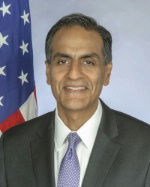
Washington, May 16 (IANS) Former US Ambassador to India Richard Verma has warned that the US-India relationship is entering a difficult phase marked by tariffs, declining student visas and reduced clean energy cooperation, even as he described India as America’s “defining partnership” of the century.
Speaking this week at the Council on Foreign Relations’ 2026 International Affairs Fellowship keynote, Verma said the relationship had expanded dramatically over the past 25 years but was now facing fresh pressure points.
“The architecture and the importance of the relationship continues to be of a paramount US national security interest,” Verma said. “And I continue to believe, as former President Obama used to say, this is the defining partnership for the United States in this century.”
Verma, currently Chief Administrative Officer at Mastercard and former Deputy Secretary of State, said the US and India had built one of Washington’s fastest-growing strategic partnerships since then President Bill Clinton’s 2000 visit to India.
“We went from $0 in defence trade in 2000 to $20 billion,” he said. “We went from $20 billion in two-way trade over 200 billion (dollars).”
He said people-to-people ties had also surged, with Indian students now representing the largest foreign student population in the United States.
But Verma acknowledged that the partnership was now under stress.
“India and Brazil were the only two countries that had 50 per cent tariffs,” he said. “It was kind of unexplainable. And still scratch your head about 50 per cent tariffs.”
“Immigration is down. Student visa issuance is down. Clean energy cooperation is down, if not eliminated,” he added.
Verma’s remarks came amid growing concern among Indian students and technology professionals over tighter US visa policies and restrictions under the Trump administration’s second term.
At another point during the discussion, Verma said Indian student visa approvals had fallen sharply. “I think the rates, at least on Indian students, were down 60-70 percent,” he said, referring to F-1 student visas.
He warned that countries such as Australia, Canada, Japan, Germany and Britain were aggressively competing for international students.
“They want these students desperately because they know what they can add to American society,” Verma said.
The former envoy also argued that India would remain central to the global balance of power over the coming decade.
“The India of 2030, just a few years away, is going to have the largest middle class, the most college graduates, the most internet users,” he said.
Verma repeatedly stressed the strategic logic behind closer US-India cooperation, citing earlier American presidents.
He recalled that President Dwight Eisenhower had predicted that “if the US and India were the closest of friends and partners the world would be a safer place”.
“President Kennedy actually said the hinge of fate in Asia rests with India,” Verma added.
Asked about India’s aspirations for permanent membership of the UN Security Council, Verma said global institutions needed reform to reflect new geopolitical realities.
“These are institutions that are in desperate need of reform,” he said. “We need to figure out how to make not only the Security Council — but the Security Council has become a place where things go to basically perish.”
Verma also highlighted growing cooperation between India and the United States in emerging technologies, especially artificial intelligence, semiconductors and critical minerals.
“If you think about bringing these incredible research scientists together, whether it’s in space, or the seabeds, or on AI, or on medicine, it’s really powerful,” he said.
–IANS
lkj/rs