



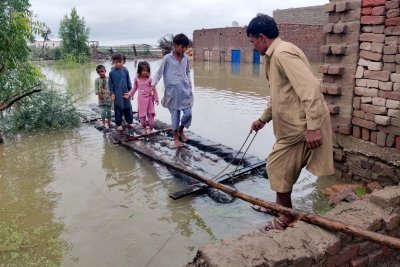
Islamabad, June 14 (IANS) The floods that occurred in recent years, rising temperatures, deteriorating drought conditions and increasing water stress in Pakistan have repeatedly showcased the institutional failures that leave vulnerable communities trapped in cycles of destruction and recovery, a report has said.
The urgency about Pakistan’s environmental crisis became impossible to ignore as policymakers gathered for the Breathe Pakistan climate conference. However, despite repeated warnings from climate experts, scientists and international organisations, critics contended that Pakistan remains trapped in reactive disaster management instead of long-term climate readiness, resulting in Pakistan facing climate extremes while millions of people face economic and social consequences, according to a report in ETRUTH MV.
In recent years, climate vulnerability of Pakistan became visible around the world during the floods that devastated several parts of the country. Entire villages submerged under water, millions of residents were displaced and critical infrastructure collapsed in Sindh, Balochistan and Punjab. Roads, crops, schools and hospitals faced damage as authorities struggled to respond to the disaster.
International organisations, including United Nations Development Programme (UNDP) and the World Bank, have repeatedly said that Pakistan’s exposure to climate disasters is increasing due to rising temperatures, melting of glaciers, and erratic monsoon patterns. However, climate adaptation planning is not same in provinces of Pakistan, with major gaps in coordination and implementation, according to the report.
Pakistan’s climate crisis is unfolding along with continuous governance weaknesses that repeatedly impact preparedness and response efforts. Environmental experts and policy analysts have frequently highlighted fragmented coordination between federal, provincial and local authorities as a major hindrance.
“Pakistan’s climate emergency is no longer defined by isolated disasters. Floods, heatwaves, droughts, water shortages and pollution are now converging simultaneously, placing enormous pressure on communities, infrastructure and the economy. The country’s environmental vulnerabilities have been intensified by years of weak planning, fragmented governance and delayed implementation,” a report in ETRUTH MV said.
“Each new disaster exposes familiar failures: inadequate preparedness, overstretched institutions and vulnerable populations left struggling to recover. As temperatures rise and weather patterns grow increasingly unpredictable, the gap between climate warnings and effective action continues to widen. For millions across Pakistan, the consequences are already visible in destroyed homes, failing crops, unsafe water and increasingly unbearable summers,” it added.
On Sunday, the Provincial Disaster Management Authority (PDMA) said that at least seven people were killed and 33 others injured in incidents caused by strong winds, lighting and rainfall in several parts of Pakistan’s Khyber Pakhtunkhwa province in the past 24 hours.
The deceased in the incidents reported from Bannu, Shangla and Mansehra include four men, one women and two children.
The casualties took place when walls and roofs of houses collapsed due to strong winds and heavy rain that occurred in various parts of Khyber Pakhtunkhwa, according to the damage assessment report released by the PDMA, Pakistan-based Geo News reported.
The latest fatalities have been reported days after at least two people were killed and 31 others were injured in rain and win-related incidents in Khyber Pakhtunkhwa earlier this month.
The Pakistan Meteorological Department has said that more rainfall is expected in upper Khyber Pakhtunkhwa and several parts of Pakistan-occupied Gilgit-Baltistan (PoGB) and Pakistan Occupied Kashmir (PoK) on Sunday, Geo News reported.
It also said that other parts of Pakistan are expected to remain hot and dry.
–IANS
akl/khz