



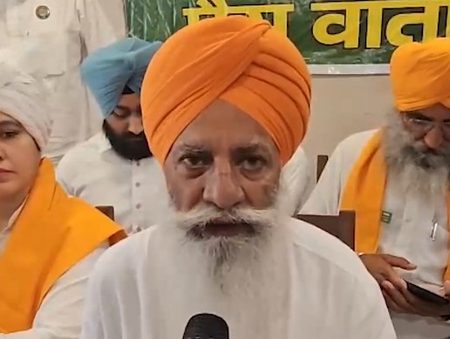
Chandigarh, June 20 (IANS) Bhartiya Kisan Union (Charuni) National President Gurnam Singh Charuni on Saturday criticised the proposed US-India trade deal, calling it an “unequal agreement”.
Speaking to IANS, the farmer leader said that pan-India agitation of all farmer unions has been called on June 23, against the proposed agreement.
Charuni said, “The trade deal is an unequal agreement. America is a bigger nation than India, having four times less population than us.”
“If we agree to their condition, India cannot decide the limit of their export nor put tax on it, then America will sell all its produce in our country, that too at a lower price. Indian farmers won’t be able to compete with them,” he added.
He cautioned that in this way farming in the nation will be destroyed, saying, “Indian farmers will be compelled to sell their lands, which will be bought by companies which will benefit from those.”
“The imported farm produce will be Genetically Modified (GM), which might cause diseases. Therefore, India will become an economic slave,” Charuni stated.
Moreover, the farmer leader said, “Protests will be staged in all cities on June 23, displaying black flags. Also, a meeting of representatives of all the farmer unions in the country has been called on the same day in Chandigarh, where we will take a call on how to hold a massive agitation similar to the 2020-2021 (farmers’ agitation).”
Gurnam Singh Charuni further mentioned that letters have been sent to all the Union Ministries connected with the US-India trade deal and also to the American Embassy in India, saying that farmers here won’t accept such an agreement, and it should be immediately halted.
Meanwhile, the Ministry of External Affairs (MEA) said on Thursday in an official statement that Prime Minister Modi met the US President Donald Trump on the sidelines of the G7 Summit in France’s Evian and discussed end of West Asia conflict, significant progress in the India-US interim trade deal and bilateral cooperation in terms of defence, strategic technologies, energy, and trade sectors between the two countries.
–IANS
cg/uk