



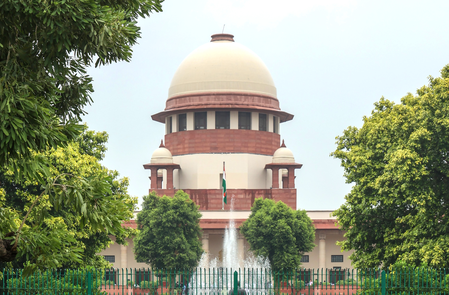
New Delhi, June 22 (IANS) The Supreme Court has set aside an Allahabad High Court judgment and a Labour Court award directing the reinstatement of a worker with back wages, holding that an employee who remained absent without authorisation and failed to substantiate his claims could not be granted such relief.
A Bench of Justices Vikram Nath and Sandeep Mehta allowed an appeal filed by M/s Rifilis Engineering Pvt. Ltd. and rejected the claim of employee Arjun Gupta, who had alleged that he was illegally removed from service after attempting to rejoin duty in June 2012.
The dispute arose after the respondent, employed as a moulder since August 2006, stopped attending work from May 14, 2012. The company claimed that he remained absent without intimation and that a notice dated May 18, 2012, was sent to his last known permanent address seeking an explanation.
The Labour Court had initially passed an ex parte award in favour of the employee in February 2022. After the matter was remanded by the Allahabad High Court for fresh consideration, the Labour Court again ruled in the employee’s favour in October 2023, directing reinstatement with 50 per cent back wages and consequential benefits. The Allahabad High Court subsequently upheld the award.
However, the Supreme Court found that both the Labour Court and the High Court had erred in granting relief in the absence of supporting evidence.
Rejecting the Allahabad High Court’s reasoning that the company had sent a notice to Gupta’s permanent address in Bihar instead of his residence in Gautam Budh Nagar, the apex court held that the employer could not be faulted for relying on the address furnished by the employee in its records.
“An employer can only be expected to communicate with an employee at the address the employee has provided. If the respondent-employee had changed his place of residence, the obligation to inform his employer of the change rested on him. He cannot be permitted to take advantage of his own omission in this regard,” the Justice Vikram Nath-led Bench said.
The Supreme Court also found no evidence supporting the employee’s contention that he had remained absent because of his mother’s serious illness or that he had informed his superior officer before leaving.
“This claim is entirely unsubstantiated. No documentary evidence has been placed on record in support of it,” the apex court observed. It further said that during the period of absence, the employee did not send any written communication explaining his absence or seeking leave.
The top court also rejected the respondent’s claim that he had returned on June 8, 2012, and attempted to resume duty but was not permitted to do so, observing that the allegation was unsupported by any documentary material.
“We find that the respondent-employee absented himself without authorisation, failed to send any written communication to his employer during his absence, has led no documentary evidence to explain his absence, and has produced no evidence of any attempt to rejoin duty,” the judgment said.
Holding that the Labour Court and the High Court erred in granting relief despite the absence of supporting evidence, the apex court allowed the company’s appeal and quashed the October 2023 award of the Labour Court as well as the March 2024 judgment of the Allahabad High Court. As a result, the directions for reinstatement, back wages and all consequential service benefits were set aside and the employee’s claim was rejected.
–IANS
pds/vd