

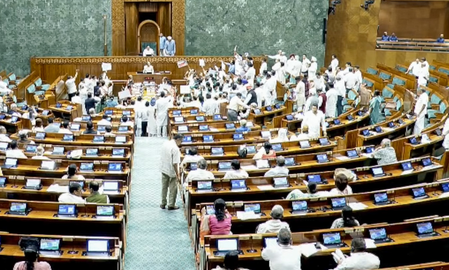
New Delhi, July 20 (IANS) Day one of Parliament’s Monsoon Session on Monday was lost amid chaotic scenes, with Opposition benches disrupting proceedings, where pleas by presiding officers to maintain decorum and allow respective Houses to function fell on deaf ears, leading to adjournments.
Historically, Parliamentary disruptions have been used as a tool of last resort by the Opposition to hold a reluctant treasury bench accountable. However, over the last decade, this tool has become the default mode of operation.
During earlier sessions, such as the 2025 Monsoon Session and the 2026 Winter Session, both the Lok Sabha and Rajya Sabha witnessed massive productivity losses, sometimes functioning at less than 50 per cent of their scheduled time. In such cases, the result is a heavy drain on the public exchequer.
Relevant reports on available estimates suggest the cost of running Parliament is an estimated Rs 2.5 lakh for every active minute. This reportedly covers the maintenance of the legislature buildings, staff, security, logistics, and the daily allowances of Members of Parliament, which stand at Rs 2,500 effective April 1, 2023.
Yet, a recent study based on information available on the websites of both Houses found that fewer than half of the total members in each had attended between 90–100 per cent of the sittings or signed the attendance register.
The allowance is over their salary of Rs 1.24 lakh, with Rs 70,000 as constituency allowance and Rs 60,000 for office allowance each month. Post-retirement benefits include pension of Rs 31,000 per month, with additional pension of Rs 2,500 for each year of service beyond the stipulated period.
In addition, they receive an annual allowance for phone and internet usage, enjoy 34 free domestic flights per year for themselves and their families, and have access to first-class train travel at any time for professional and personal use. They can also claim a mileage allowance for road travel. MPs are further entitled to 50,000 free units of electricity and 4,000 kilolitres of water annually. The government also provides for their housing and accommodation, where those who choose not to utilise it are eligible to receive a monthly housing allowance.
Such pay and perks ensure they earn even during adjournments, while the time for crucial Bills, national security debates, and pressing economic queries is routinely washed away without implementing the hours intended for intense scrutiny and constructive legislative output.
Over the last decade, repeated walkouts, protests and forced adjournments have resulted in an estimated loss of thousands of crores in taxpayer money. Under such circumstances, when Parliament is unable to function normally, Ordinances and major legislative Bills are often rushed through without adequate scrutiny or standing committee reviews. This undermines the very foundation of the Indian Constitution, which mandates the legislature as the primary forum for resolving complex national issues.
Parliamentary rules provide ample mechanisms for urgent debates. Yet, rather than utilising these established Parliamentary provisions to debate issues in a structured manner, protesting members frequently resort to trooping into the Well of the House, approaching the Chair, raising slogans, and displaying banners.
Presiding Officers have historically struggled to maintain a balance, sometimes resorting to physical removal and suspensions, but these, too, have resulted in further antagonism.
The continuous uproar on day one of the current Monsoon Session underscores a troubling intent for televised theatrics over legislative debate.
Meanwhile, the government is deprived of critical legislative review and clearances, and the Opposition loses its chance to secure meaningful answers from the treasury benches on issues of national concern.
Electors, who also fund the Parliamentary ecosystem, expect their representatives to deliberate on matters ranging from national security and economic policy to education and healthcare.
–IANS
jb/dan