



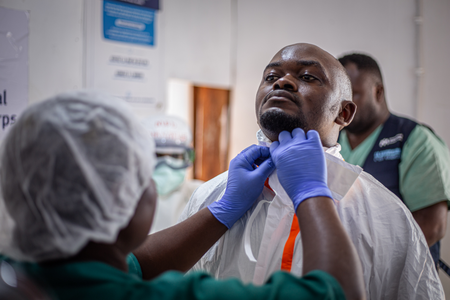
Kinshasa, Sep 16 (IANS) The Ebola outbreak in the Democratic Republic of the Congo (DRC) remains “uncontrolled” despite an overall decline in cases and deaths, as the epidemic follows increasingly different trajectories across affected parts of the country, the World Health Organisation (WHO) said Wednesday.
“The outbreak remains uncontrolled and increasingly heterogeneous,” the WHO Regional Office for Africa said in its latest weekly situation report.
For much of the outbreak, the eastern province of Ituri has been the epicenter of transmission and still accounts for almost 80 percent of confirmed cases. Infections there have been declining since mid-August, helping drive down the national caseload.
“The peak is behind us (in Ituri). We are already on the downward slope,” Jean-Jacques Muyembe, a veteran Congolese virologist heading the country’s National Institute of Biomedical Research, said late Tuesday in Kinshasa, noting “a clear improvement” in the fight against Ebola in Ituri.
That modest national decline, however, masks what the WHO described as “a pronounced geographic redistribution of transmission.” Over the latest three-week period, confirmed cases fell by about 6 per cent nationwide, driven largely by a 25-per cent drop in Ituri, while cases surged by more than 76 per cent in neighbouring North Kivu, Xinhua news agency reported.
North Kivu, the second-most affected province after Ituri, is now moving in the opposite direction. The WHO described a “sharp and sustained increase” there, with the province recording its “highest incidence” since the outbreak began, as the flare-up in North Kivu has been broad-based rather than confined to a few hotspots.
North Kivu now accounts for about one-third of new cases and more than one-third of new deaths nationwide, as its worsening outbreak increasingly offsets the gains made in Ituri, according to the WHO.
Muyembe nevertheless cautioned that progress in some areas did not mean the epidemic was over, as transmission remains uneven and continues to intensify elsewhere. He stressed the need to further strengthen contact tracing and other response measures.
At the same time, researchers are moving closer to results from several experimental vaccines and treatments, as no vaccine or specific therapy has yet been approved for disease caused by Bundibugyo ebolavirus, the strain behind the current outbreak.
Ervebo, a vaccine approved against Zaire ebolavirus, is being used in the DRC under a compassionate-use framework and research protocols to determine whether it can offer some protection against Bundibugyo ebolavirus. A total of 2,307 health and frontline workers had received the vaccine by Sep 13, about 20 per cent of the targeted group, according to the WHO.
Placide Mbala, Director of Research, clinical trials and innovation at the Africa Centers for Disease Control and Prevention, said Tuesday that laboratory findings and field observations had provided grounds to investigate possible cross-protection, but stressed that they did not yet amount to proof. Clinical studies are now underway to assess whether the vaccine can reduce infection, severe disease or deaths.
Research on treatments and prevention is also advancing. Mbala said a clinical trial evaluating post-exposure prophylaxis for people at high risk of infection has been moving forward, with an initial analysis potentially available by the end of this month.
Separately, the WHO said 128 people had received investigational treatment or prophylaxis, including 16 confirmed patients and 112 high-risk contacts receiving post-exposure prophylaxis. The WHO-sponsored PARTNERS trial is testing the experimental monoclonal antibody MBP134, remdesivir and their combination in confirmed patients.
“Although the response has been unprecedented in its scale, the epidemic continues to expand,” said Olivier le Polain, head of epidemiology and analytics for response at the WHO, Tuesday at a UN briefing in Geneva, warning that the high caseload and wide geographic spread meant it would take “many, many months” to bring the outbreak fully under control.
Muyembe did not give a new deadline for containing the outbreak, saying only that response teams should “do everything possible so that we can celebrate the New Year under better conditions.”
The DRC government’s latest situation report, with data through Sept. 13, showed that the country had recorded 7,258 confirmed Ebola cases, including 3,510 deaths, across 62 health zones in seven provinces.
The current outbreak has become the largest and deadliest Ebola epidemic in the DRC’s history and the second-largest globally, after the 2014-2016 epidemic in West Africa.
–IANS
/as