



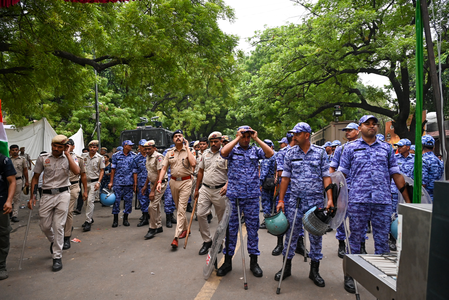
New Delhi, Oct 7 (IANS) The Delhi High Court on Wednesday directed the government to treat a public interest litigation (PIL) seeking mandatory use of body-worn cameras by Delhi Police and Rapid Action Force (RAF) personnel deployed for crowd control and protest management duties as a representation.
A bench of Acting Chief Justice Nitin Wasudeo Sambre and Justice Arun Bhardwaj directed the government to take a decision within six months on the framing of a standard operating procedure (SOP) concerning the use of body-worn cameras by police and RAF personnel during protests and crowd-control operations.
The High Court passed the order while disposing of a PIL filed by advocate Chahat Raghav in the aftermath of the July 2026 demonstrations at Jantar Mantar involving the Cockroach Janata Party (CJP) and climate activist Sonam Wangchuk.
Senior advocate Akhil Sibal, appearing for the petitioner, submitted that the Delhi Police’s existing framework relies on third-person videographers positioned along the periphery and does not provide an adequate mechanism for contemporaneous recording of actions by personnel deployed for crowd control.
He argued that the availability of technology for body-worn cameras could go a long way in ensuring transparency and fixing accountability during crowd-control operations.
“If technology is available, it can go a long way in fixing accountability whenever required. It is different from facial recognition where there are concerns of surveillance,” the senior counsel argued.
Additional Solicitor General Chetan Sharma, appearing for the Centre, submitted that the petition could be treated as a representation and that a decision would be communicated within six months.
Referring to a Supreme Court judgment and the Delhi High Court rules, ASG Sharma said that a representation was required to be made to the authorities concerned before invoking the PIL jurisdiction.
The Centre also submitted that guidelines were already in place for organising protests and that videography was covered under the existing framework. It said the petitioner could make a representation seeking framing of an SOP for the use of body-worn cameras, which could be considered in accordance with law.
With the government agreeing to consider the issue as a representation and communicate its decision within six months, the High Court disposed of the PIL.
The plea was filed against the backdrop of clashes during the July protests at Jantar Mantar, which resulted in injuries to student protesters as well as more than 50 police and paramilitary personnel.
According to the petition, the events exposed a “systemic vacuum” as there was no rule, regulation, standing order or SOP mandating police or RAF personnel to wear body-worn cameras while deployed on crowd-control duties, or governing the storage, integrity, retention and evidentiary use of such footage. The petitioner said the July 2026 protests had seen allegations of disproportionate use of force by police, while there were also allegations of attacks on police personnel and vandalism by some protesters.
It submitted that a contemporaneous and tamper-proof officer’s-eye recording could help fix accountability for alleged excesses by the police and also provide authenticated evidence to identify and prosecute persons in the crowd who resorted to violence.
The plea further claimed that Delhi Police had itself recognised the need for body-worn cameras during protests as far back as January 2020, but had not translated that recognition into a binding and effective regime. It referred to Delhi Police Standing Order No. L&O/10/2022 concerning regulation of rallies and processions, submitting that the existing framework provides for third-person videography but does not mandate body-worn cameras for personnel engaged in crowd control.
The petition also claimed that Delhi Police had floated a tender for procurement of 1,500 body-worn cameras at a total value of around Rs 7.4 crore, while the CRPF had initiated procurement of 480 such cameras for the RAF. The petitioner sought directions for framing and enforcement of a binding SOP mandating compulsory, always-on body-worn cameras for police and RAF personnel deployed on crowd-control and protest-management duties, along with a data-storage, integrity and evidentiary regime governing the footage.
–IANS
pds/vd