



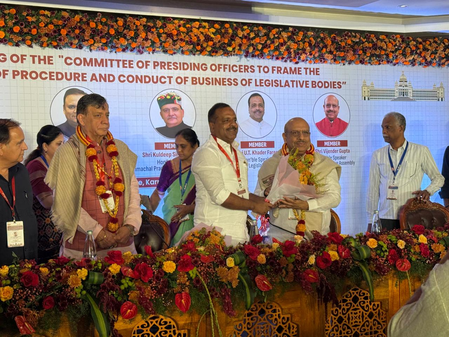
Mysuru, May 12 (IANS) Delhi Assembly Speaker Vijender Gupta on Tuesday endorsed a proposal to evolve a Uniform Model of Rules of Procedure and Conduct of Business for Legislative Bodies at a consultation held in Mysuru, an official said in a statement issued in New Delhi.
Speaking at the Preliminary Meeting of the “Committee of Presiding Officers to frame the Uniform Model of Rules of Procedure and Conduct of Business of Legislative Bodies”, Speaker Gupta said, “Uniformity in legislative procedures is no longer merely desirable; it has become an institutional necessity in the era of digital legislatures and technology-driven governance.”
He added that harmonised rules of procedure will strengthen transparency, executive accountability and coherence across India’s democratic institutions.
The meeting was held under the chairmanship of Speaker of the Uttar Pradesh Vidhan Sabha Satish Mahana.
The conference is being attended by Maharashtra Assembly Speaker Ram Shinde, Nagaland Assembly Speaker Sharingain Longkuner, Himachal Pradesh Assembly Speaker Kuldeep Singh Pathania and Karnataka Assembly Speaker Khadeer Fareed as part of a coordinated national initiative aimed at evolving a broad procedural framework for legislatures across the country.
Welcoming the decision earlier taken at the 85th All India Presiding Officers’ Conference held in Patna, Speaker Gupta described the move as a historic and forward-looking institutional reform capable of bringing greater coherence, transparency and efficiency to legislative functioning across India.
Referring to the constitutional framework governing legislative procedures, Vijender Gupta said that Article 118 of the Constitution empowers both Houses of Parliament to frame rules regulating their procedure and conduct of business, while Article 208 grants similar powers to State Legislatures.
He noted that Section 33 of the Government of National Capital Territory of Delhi Act, 1991, in Delhi empowers the Delhi Assembly to frame its Rules of Procedure and Conduct of Business, provided such rules remain consistent with the Rules of Procedure and Conduct of Business in the Lok Sabha.
He said that these constitutional provisions establish the sovereignty of Legislatures in regulating their internal functioning while also enabling legislatures to voluntarily adopt tested parliamentary practices, conventions and procedural innovations in the larger democratic interest.
–IANS
rch/khz