



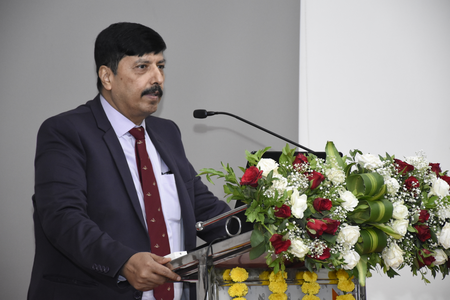
Gandhinagar, April 23 (IANS) Gujarat Chief Secretary Manoj Kumar Das on Thursday underlined that decisions taken at the Secretariat level have a long-term impact on governance and public welfare, as they continue to influence citizens’ lives for years after their implementation.
He was addressing the inauguration of a three-day training programme for Deputy Secretaries of the State Secretariat, organised by the Sardar Patel Institute of Public Administration (SPIPA) in Gandhinagar from April 23 to 25.
The programme, themed “Enhancing Administrative Capacities and Leadership”, has been designed to strengthen administrative skills in the context of emerging governance challenges and technological transformation.
Das said that the role of Secretariat officers is “extremely important” as policy decisions taken at this level have enduring consequences.
“Earlier resolutions of the Secretariat are still impacting the lives of lakhs of citizens. Therefore, decisions must always be correct, good and accurate,” he said, adding that administrative responsibility demands careful judgement and clarity.
Highlighting the pace of technological change, he noted that advancements in artificial intelligence and digital systems are transforming governance at a rapid rate.
He said officers must continuously update their knowledge and remain aligned with evolving technologies.
“In today’s era, where AI and new technologies are advancing rapidly, it is necessary for officers to keep learning and stay updated,” he said.
He further stressed the need to simplify administrative procedures to reduce unnecessary documentation for citizens accessing government services.
According to him, stronger coordination between field-level officers and Secretariat officials is essential to ensure that administrative decisions remain citizen-centric and sensitive to ground realities.
Das also stated that Gujarat’s administrative system must align with the broader national vision of ‘Viksit Bharat 2047’.
He said the state’s development journey should aim to achieve global standards in sectors where it is already performing well, while striving for a top national ranking in others.
“Every officer and employee plays an important role in this journey of development,” he said, adding that files should be viewed not as paperwork but as instruments of public welfare.
He further observed that disciplined and committed daily functioning of the administrative machinery directly contributes to the development of both the state and the country.
Additional Chief Secretary, General Administration Department, Dr Anju Sharma, who also addressed the programme, said that continuous learning is essential in public administration.
She noted that governance systems must evolve with time by adopting new knowledge, modern technology and data-driven methods.
She said the training includes technical sessions on artificial intelligence, cybersecurity and the PM Gati Shakti portal, which are expected to strengthen project planning and execution.
Dr Sharma emphasised that decision-making should be based on evidence and data rather than traditional assumptions.
“Officers should adopt evidence-based decision-making for greater transparency and accuracy in governance,” she said.
She added that discussions during the programme would cover citizen-centric administration, the SWAGAT grievance redressal system, the Good Governance Index, time-bound disposal of departmental matters, and strategies linked to the vision of ‘Viksit Gujarat 2047’.
Sessions on leadership development and emotional agility have also been included to help officers handle high-pressure administrative situations effectively.
SPIPA Director General Hareet Shukla said the training is intended to prepare officers for both present responsibilities and future challenges.
“Promotion in government service brings enhanced responsibility rather than merely a change in designation. The programme will provide guidance on administrative rules, digital governance systems, financial management through IFMS, and efficient file disposal,” he noted.
He added that officers would be trained to view administrative procedures as tools of public welfare and to strengthen decision-making capabilities in line with governance objectives.
Senior SPIPA officials and Deputy Secretaries from various departments were present at the inaugural session of the training programme.
–IANS
mys/uk