



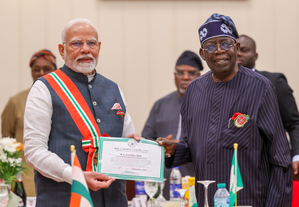
Abuja/New Delhi, June 13 (IANS) The India-Nigeria relationship is not a story of one country projecting power over another but one rooted in mutual recognition and shared aspirations.
As two large, youthful democracies of the Global South, India and Nigeria are navigating common challenges ranging from pressures of development and inequality to migration and global competition. This is why the people-to-people dimension of the relationship assumes particular significance, providing a social foundation that can endure beyond political cycles and economic fluctuations, a report has stated.
“When Nigerians think of India, many do not think first of diplomacy, trade figures, or official communiqués. They think of the Indian teachers who shaped their classrooms, the doctors who treated their families, the Indian shops in their neighborhoods, the Bollywood films that found a loyal audience in northern Nigeria, and the Indians who have lived, worked, and raised families in cities across the country,” Osaze Efe, a senior policy fellow at Tanzania-based Amani Research Initiative, wrote in ‘India Narrative.’
“That is the real foundation of India-Nigeria relations: people-to-people contact that has grown steadily over decades and remains one of the strongest links between both countries,” he added.
According to the expert, the relationship between the two nations is often viewed through the prism of oil, defence, and business, but that overlooks a large story.
“The India-Nigeria connection is also a cultural one, and in many ways that is the more durable tie. It lives in shared meals, shared screens, shared schools, and shared city spaces. It is visible in the everyday interactions between Nigerians and Indians and in the growing number of students, entrepreneurs, professionals, and artists moving between both countries,” Efe stated.
Highlighting the Indian community’s significant contribution to social and economic life in Nigeria, he said that Indians are active in several sectors, including retail, manufacturing, education, healthcare, and hospitality. In many cases, Efe said, the Indian diaspora employs local workers, supports local economies, and engages closely in community life.
“Their presence is most visible in Lagos, Abuja, and other major commercial centers, where Indian schools, temples, cultural associations, and businesses form part of the urban landscape,” he noted.
Efe further noted a growing number of Nigerians are travelling to India in pursuit of education, business, and professional opportunities.
“For many young Nigerians, India offers a combination of affordable tuition, English-language instruction, and access to medical, technical, and management training. Thousands of Nigerians have studied in Indian universities over the years, and many have returned home to contribute in medicine, engineering, business, and public service,” he mentioned.
Emphasising that the India-Nigeria relationship is about much more than trade, he said the two peoples have been connected for decades, “often quietly and without fanfare.” Those ties, he noted, have been nurtured by teachers, students, traders, doctors, filmmakers, worshippers, and migrants who have forged bonds far deeper than official language sometimes suggests.
–IANS
scor/as