



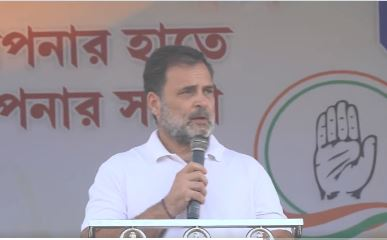
New Delhi, April 14 (IANS) Congress leader Rahul Gandhi’s choice of Malda district to launch his party’s campaign on Tuesday ahead of the 2026 Assembly election in West Bengal reflects an attempt at a toehold where the ground has fast been eroding under its feet since over a decade.
Malda is crucial for the Congress, once its bastion, which has since witnessed shifting political equations over the years. That shift, hopes the Congress, can be turned somewhat, riding on the work of party stalwart Abu Barkat Ghani Khan Choudhury, whose legacy continues two decades after his death on this day.
Fondly remembered as “Barkatda”, he is still hailed in Malda, where folklore has it that every family in the region as having at least one member being a direct beneficiary from his largesse. People recall how he would personally intervene in local disputes, arrange jobs, or ensure railway tickets for needy constituents. He leveraged his ministerial clout to bring central government projects to Malda, creating jobs, and modernising the district’s facilities, while championing schools and colleges in the district. Malda’s political character is deeply shaped by its demography.
According to the 2011 Census, Muslims constituted 51.27 per cent, and Hindus 47.99 per cent of the population – making it West Bengal’s second-most Muslim-majority district after Murshidabad. Rural population dominated at 86.42 per cent in the district. Malda’s political violence in this century has ranged from 2016 Kaliachak riots, to electoral clashes in 2018 and 2021), apart from the recent incident of an attack on judicial officers in Mothabari. These reflect the district’s strategic vulnerability and political volatility.
The erstwhile Malda Lok Sabha constituency has been represented by Barkat Ghani Khan Choudhury eight time since 1980, even at the height of Left influence, till he died in 2006. The seat then returned his brother Abu Hasem Khan Choudhury who has also been a Union Minister of State in the Manmohan Singh government. Since the delimitation of 2009, the Congress has represented both Maldaha Uttar and Dakshin seats, where Abu Hasem Khan Choudhury won from the latter in 2009, 2014, and 2019, and later, his son Isha Khan Choudhury in 2024.
In Maldaha Uttar Lok Sabha constituency, Isha’s cousin, Mausam Noor won in 2009 and 2014 as a Congress candidate, but lost to Bharatiya Janata Party’s (BJP) Khagen Murmu in 2019 on a Trinamool Congress ticket. She was made a Rajya Sabha member by the Trinamool, which she quit recently to return to Congress.
Meanwhile, Murmu, a former communist leader, retained the seat for the BJP again in 2024. Noor will now contest from the Malatipur Assembly segment for the Congress – where it is expecting a turnaround – pitted against the Trinamool’s sitting MLA Abdur Rahim Boxi. The Trinamool won three other seats in the 2021 Assembly election, ceding ground to the Congress in all four segments in 2024 Lok Sabha poll at Maldaha Uttar. The BJP won the other three segments, retaining its lead in 2024.
Among Maldaha Dakshin Lok Sabha constituency, the BJP could win only one Assembly segment in 2021, while the Trinamool clinched the rest, including the two Vidhan Sabha seats that fall in Murshidabad district. Thus, in the last Parliamentary election, out of the 12 Assembly segments within Malda district, the BJP and the Congress led in six each, leaving none for the Trinamool. The Congress also led the other two Assembly segments that come under Murshidabad.
In 2016 Assembly elections, out of these dozen seats, the Congress had won eight, Trinamool three, and the BJP one.
The upcoming poll may see a multi-cornered contest, with the Left Front-Indian Secular Front alliance, the All India Majlis-e-Ittehadul Muslimeen (AIMIM), and the newly formed Janata Unnayan Party also in fray. Along with the presence of Trinamool and Congress candidates, it can potentially split Muslim vote, giving some edge to the BJP. The district’s polling will occur on April 23 in Phase 1, with counting scheduled for May 4.
–IANS
jb/uk