



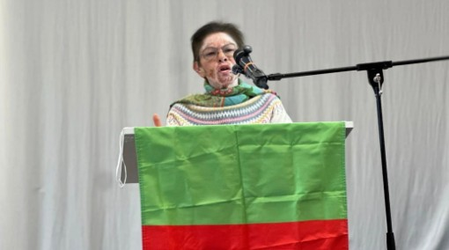
Berlin, Nov 16 (IANS) Pakistani political analyst and author Ayesha Siddiqa sharply criticised Pakistan’s state structure, describing it as a “colonial and rent-seeking state” that has taken the form of “constitutional militarism”.
Addressing a conference in Germany’s Hannover, organised by the Baloch National Movement (BNM), Siddiqa said that Pakistan was a bureaucratic polity from its inception rather than a genuine political state, adding that the military’s dominant role in the country’s affairs was not accidental.
The event was organised to mark Baloch Martyrs’ Day, observed by Baloch communities worldwide on November 13 each year to pay tribute to those who lost their lives in the struggle for rights, dignity and freedom of the people of Balochistan.
According to the BNM, Siddiqa expressed loss of confidence in the Pakistani authorities’ ability to protect its citizens or the capacity to address their grievances. She said that forcible abduction of sons and daughters from their parents by Pakistani authorities was an act that can never be justified.
Siddiqa further stressed that state violence and authoritarianism have intensified, reiterating that she no longer trusts the system.
She also criticised Pakistani political parties and parliament, saying they have effectively surrendered their authority.
“According to her, parliament has willingly approved restrictions on the media and other measures demanded by the military. She said institutions including the judiciary and civil bureaucracy have been weakened, while an alliance of military and civilian elite interests now dominates the distribution of resources,” the BNM stated.
Linking enforced disappearances, fear and repression to resource extraction, Siddiqa said the Pakistani authorities were prepared to sell mineral resources from Pakistan’s provinces including Balochistan, Khyber Pakhtunkhwa and other regions without “effective public consultation or accountability”.
She said that “fear, silence and repression are used as tools to sustain this process and protect the interests of those who control the resources”.
Referring to a recent conference in Islamabad attended by Pakistani Army Chief Asim Munir, she said that “mineral resources were being offered without taking parliament into confidence or consulting the people of the areas concerned”.
Speaking at the same event, a Spanish journalist, Karlos Zurutuza, who has reported on Balochistan, said the province remained almost invisible in the international media despite its strategic location and the severe risks faced by reporters.
Zurutuza said that foreign journalists face serious obstacles, citing cases of New York Times reporters, including Carlotta Gall, who he said was beaten and expelled in 2006, and another reporter expelled after a single story.
He also cited figures from Islamabad-based media watchdog Freedom Network, stating that at least 40 journalists have been killed in Balochistan over the past two decades.
–IANS
scor/sd/