



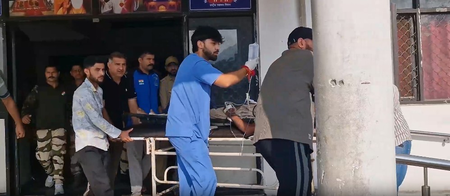
Jammu, Oct 9 (IANS) A Central Industrial Security Force (CISF) trooper suffered a gunshot injury on Friday while on duty in Jammu and Kashmir’s Reasi district, officials said.
The officials said the circumstances leading to the incident are being ascertained. The injured trooper was identified as Mohammad Mushtaq, a resident of Mari village in Reasi district. He was shifted to the Reasi district hospital for treatment.
The incident occurred around 9.10 a.m. while the trooper was on active duty. The officials said he was first rushed to the District Hospital, where doctors provided emergency first aid before referring him to an advanced facility in Jammu due to his critical condition.
More details are awaited.
It must be recalled that on September 29, four CISF personnel were killed during a firing incident at the Sewa-II Hydroelectric Project unit in the Mashka area in Kathua district following an altercation among deployed staff.
An internal inquiry was launched, and the accused head constable was handed over to the police. Those killed included Assistant Commandant Ankit Kumar Pandey, Sub-Inspector Lakshman Singh, and constables Rafiq Ahmed and Sandeep Kumar.
On November 3, 2025, Naik Amarjeet Singh died inside a military camp due to an accidental rifle discharge. The incident occurred while he was actively performing sentry duty at the camp. Despite being immediately evacuated to a nearby field hospital, he succumbed to the bullet injuries.
On August 29, 2025, an accidental firing incident claimed the life of Naik Uppala Ravi Kumar in Ganderbal district. He was deployed with the 54 Rashtriya Rifles. Local police registered a formal case after initial investigations confirmed his service rifle went off unintentionally while he was on duty.
Accidental weapon discharges involving deployed security forces in Jammu and Kashmir primarily occur during routine sentry duties, vehicle transits, or immediately following shifts.
Operational pressure, challenging terrains, and constant weapon readiness are key contextual factors.
–IANS
sq/dpb