



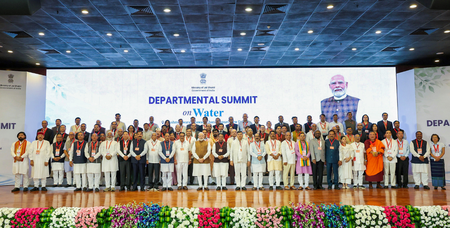
New Delhi, Sep 2 (IANS) Chhattisgarh has emerged as a national frontrunner in water conservation, Chief Minister Vishnu Deo Sai said while presenting the state’s achievements at the Ministry of Jal Shakti’s departmental summit held in New Delhi on September 1–2, 2026.
The state secured the top position in the third phase of the ‘Jal Sanchay Jan Bhagidari’ (JSJB) and ‘Catch the Rain’ campaigns, underscoring its leadership in rainwater harvesting and groundwater recharge, he said.
Highlighting the state’s model, CM Sai said that Chhattisgarh, which accounts for nearly 4% of India’s geographical area, has transformed water conservation into a mass movement by involving farmers, panchayats, and local communities alongside government initiatives.
“Instead of limiting water conservation to government programmes alone, the state has empowered local communities,” he said while showcasing the participatory approach that has driven success. Under JSJB 1.0 and 2.0, Chhattisgarh consistently ranked second nationwide, completing millions of conservation structures.
In the latest JSJB 3.0 phase, the state rose to the top, recording extensive rainwater harvesting and recharge structures. Districts such as Surajpur, Mahasamund, Balod, Baloda Bazar-Bhatapara, and Kabirdham secured places among the top 10 districts in the country, reflecting the widespread adoption of water-saving practices, he said.
The impact of these efforts is visible in the decline of groundwater-stressed blocks in Chhattisgarh, which fell from 26 to a significantly lower number, indicating improved water availability.
Retaining rainwater in fields and villages has boosted irrigation potential, supported crop production, and reduced the burden on women who traditionally spend long hours collecting water.
Prime Minister Narendra Modi’s message of “Catch the Rain — Where It Falls, Let It Be Stored” has been implemented in Chhattisgarh with region-specific strategies, the chief minister said.
The state’s experience demonstrates that convergence among schemes, geo-tagging of structures, and regular monitoring can make water conservation sustainable and scalable.
The summit also noted India’s target of creating 2 crore new water structures by May 2027, with Chhattisgarh’s participatory model serving as a blueprint for other states.
Senior officials, including Principal Secretary Subodh Kumar Singh and Water Resources Secretary Rajesh Sukumar Toppo, accompanied the Chief Minister at the event, reinforcing the state’s commitment to long-term water security.
–IANS
sktr/uk