



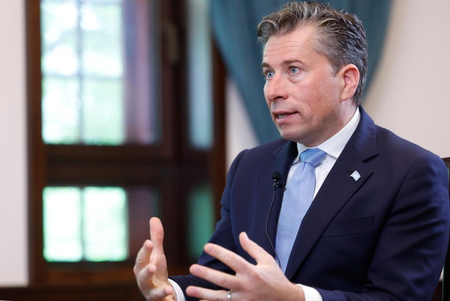
United Nations, Aug 20 (IANS) Cheap armed drones are transforming modern warfare and creating a “dystopian reality” in which civilians and humanitarian workers can be deliberately targeted from a distance, the United Nations’ relief chief has warned.
Tom Fletcher, UN Under-Secretary-General for Humanitarian Affairs and Emergency Relief Coordinator, said rapidly advancing technology was extending the reach of wars while weakening accountability for those responsible for attacks.
Speaking from Ukraine on World Humanitarian Day, Fletcher said nearly 1,000 aid workers had been killed, injured or kidnapped, with governments responsible for much of the violence.
“This is not a temporary spike that we’re seeing. This is a stain. It is the normalisation of violence against our community, and we will not accept it,” he said.
“We do not accept it. We will not allow this violence, this killing of humanitarians, to be normalised,” Fletcher said.
He pointed to what he described as a pervasive sense of impunity surrounding attacks on humanitarian personnel.
“And behind it all, this sense we feel of impunity, of a lack of accountability for those who pulled the trigger, those who gave the order, those who supplied the weapon, those who created the environment in which it could be used in that way,” he said.
Fletcher spoke after visiting Kherson in southern Ukraine, which he described as an epicentre of armed-drone attacks against civilian areas.
He said the experience offered a glimpse of a disturbing future that was already a daily reality for people in Ukraine and other conflict zones, including Somalia, Sudan, Gaza and Lebanon.
Fletcher travelled several times along a route between Mykolaiv and Kherson known locally as the “Road of Death.” Stretches of the road have been covered with protective netting intended to stop or deflect drones.
“I’ve not been anywhere — and you know, I spend my time in pretty tough neighbourhoods — I’ve not been anywhere where drones are so much part of the conversation,” he said.
Residents, including children, had learned to identify different weapons by sound, ranging from first-person-view and fibre-optic drones to medium-range drones and loitering munitions, he said.
“And so these weapons have become part of life and part of the language of people here, and that’s pretty chilling,” Fletcher said.
He said drone operators could inspect their intended targets before launching an attack.
“If they fly around the person selling fruit and vegetables in the market, or the humanitarian delivering food, they have a good look at them before they take the shot that will kill or maim them for life,” he said.
Doctors at one hospital told him that about 70 per cent of their wounded patients had suffered blast injuries from drones. Hospital wards and operating theatres were being moved underground for protection.
Fletcher said a drone that had inflicted significant damage on Kherson Hospital cost only $300, illustrating the growing availability of inexpensive weapons.
He warned that the growing distance between attackers and their victims was being accompanied by an increasing distance between the victims and justice.
International humanitarian law, he said, must continue to protect civilians regardless of how sophisticated weapons become.
“So we need those investigations. We need accountability. We need the international community to uphold the law,” Fletcher said.
The threat was not limited to Ukraine. Fletcher said women in Somalia had told him that they were fleeing drones rather than famine or other violence. He also cited the expanding use of armed drones in Sudan, Colombia, Gaza and Lebanon.
“So, from Sudan to Colombia to Gaza to Lebanon, these cheap armed drones are extending the reach of war and allowing people to kill at greater distance,” he said.
Fletcher urged governments and the companies manufacturing and supplying the weapons to understand how they were being used and comply with international humanitarian law.
“Concern from Member States is not enough. We need action right now,” he said.
He acknowledged that drones could serve humanitarian purposes, including delivering vaccines to isolated communities and locating survivors after earthquakes. But he warned that their military use was advancing faster than systems of accountability.
“We need to ensure that technology does not outpace humanity and that technology does not outpace accountability,” Fletcher said.
–IANS
lkj/sd/